Photovoltaic Industry Macro Dynamics: Policy Adjustments Plus Market Opportunities
Dec 19, 2024
1. Policy vane: Leading the industry forward
New changes in export tax rebates According to the announcement issued by the Ministry of Finance and the State Administration of Taxation, from December 1, 2024, the export tax rebate rate for some finished oils, photovoltaics, batteries, and some non-metallic mineral products will be reduced from 13% to 9%. This adjustment has had a certain impact on the export costs of photovoltaic companies, accelerated the process of survival of the fittest in the industry, and prompted companies to pay more attention to technological innovation and cost control. The production cost control of related accessories PV Fuse is also very important.

Revision of industry normative conditions The Ministry of Industry and Information Technology officially issued the revised "Normative Conditions for Photovoltaic Manufacturing Industry (2024 Edition)" and "Management Measures for Photovoltaic Manufacturing Industry Normative Announcements (2024 Edition)" on November 20, 2024. The new norms raise the threshold for investment and technical indicators, strengthen quality management and intellectual property protection, and guide enterprises to improve the level of green development. The introduction of this policy will help regulate the market order of the photovoltaic industry and promote the industry to move towards high-quality development. 3. Industry self-discipline and foreign trade Recently, a self-discipline meeting of foreign trade enterprises in the photovoltaic industry was held in Beijing. Many representatives attended and called on enterprises to strengthen self-discipline. At the same time, the China Photovoltaic Industry Association also took the lead in convening a special symposium on promoting high-quality and sustainable development of the photovoltaic industry. Many photovoltaic industry chain enterprises signed a self-discipline convention and controlled production capacity. These measures will help alleviate the problem of overcapacity and maintain fair competition order in the market.
The wild growth period from 2009 to 2012 marked the initial development of my country's photovoltaic industry. From 2013 to 2017 was the policy guidance period. Various national departments issued a series of photovoltaic industry support policies, gradually laying the foundation for China's photovoltaic industry to lead the world in the entire industry chain. From 2018 to 2020, the grid parity transition period was marked by the 531 new policy in 2018, and the photovoltaic industry gradually got rid of its dependence on subsidies. Entering the "14th Five-Year Plan" period, the photovoltaic industry has played an indispensable role in China's energy structure transformation and the realization of the "dual carbon" goal, accelerating the green and low-carbon transformation of the energy system. The green production of related accessories PV Fuse is also a very important part of the transformation.
2. Market trend: demand continues to grow
Demand for new photovoltaic installations at home and abroad Although the demand for new photovoltaic installations at home and abroad will slow down in 2024, there is still broad room for long-term development. According to the forecast of the China Photovoltaic Industry Association, my country's new photovoltaic installed capacity is expected to increase to between 230GW and 260GW in 2024, and the global new photovoltaic installed capacity forecast will also be adjusted upward to between 430GW and 470GW. This data shows that the photovoltaic industry is still maintaining a strong growth momentum. 2. Development of distributed photovoltaics With the full entry of photovoltaic power generation into the era of parity and the promotion of the whole county promotion policy, distributed photovoltaic projects will still maintain a certain market share. Especially with the integrated development of construction, transportation and other fields, distributed photovoltaics will become an important part of the future photovoltaic market.

3. New frontier of industry technology: innovation leads the future
(1). Advanced technology of high-efficiency crystal return silicon battery
TOPCon 3.0 technology continues to evolve: optimize battery structure design, reduce interface recombination loss, and improve doping process. The mass production efficiency of TOPCon 3.0 cells of some enterprises has exceeded 25.5%, and it is expected to be higher in the future. HJT cell technology innovation and development: Improve amorphous silicon deposition technology and TCO film preparation process to reduce costs and improve efficiency. It is expected that the mass production efficiency will exceed 26% in the next few years. IBC cell technology integration innovation: Explore the integration with other high-efficiency cell technologies to form hybrid structure cells, such as TOPCon-IBC cells with an efficiency of over 27% in the laboratory, and have broad prospects in high-end application fields. These high-end technologies also promote related accessories Solar Photovoltaic Fuses.
(2). Perovskite and tandem cell technology breakthroughs Key technologies for improving the stability of perovskite cells
Adopt new material systems, optimize crystal structures, innovate packaging technologies, improve stability, and meet the basic requirements of outdoor applications. Perovskite/crystalline silicon tandem cell efficiency leap: Accurately design the band structure, optimize the thickness and quality of each layer, the laboratory conversion efficiency has exceeded 31%, and it is expected to be higher in the future, promoting the industry to develop towards high efficiency.

(3). Smart photovoltaic system integration and optimization Smart photovoltaic power station optimization control technology
With the help of sensors, big data and artificial intelligence, the power station can be finely managed, the power generation efficiency can be improved, and the operation and maintenance costs can be reduced. Distributed photovoltaic smart microgrid technology: Distributed photovoltaics are combined with energy storage and smart grid equipment to form a microgrid system to achieve energy self-sufficiency, flexibility and control, and interact with other equipment to improve energy utilization efficiency.
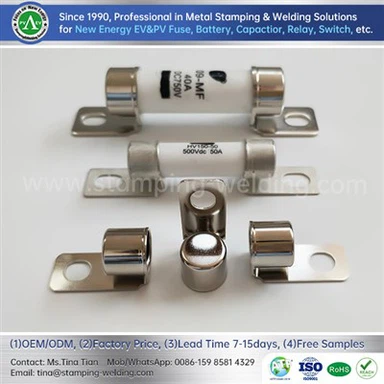
We are a new energy hardware accessories manufacturer located in Xiamen, China. We have our own factory and advanced production equipment to provide you with high-quality photovoltaic related accessories such as PV Fuse, Solar Photovoltaic Fuses, Solar PV Protection Fuse series, etc. At the same time, we also have professional engineers who can provide you with technical consulting services. If you are interested in our products and services, please click the business card below to contact us!