Structural Characteristics And Industrial Selection & Application Guide For Copper Electrical Fuse Contacts
Jul 29, 2026
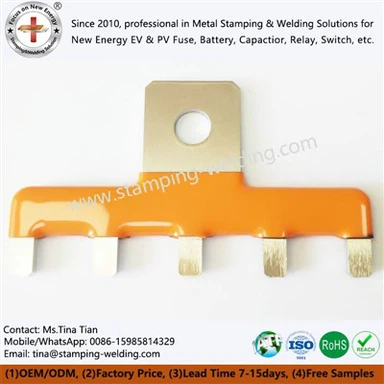
Copper Electrical Fuse Contacts serve as the core conductive components for low-voltage knife-blade fuses. Machined from high-conductivity pure copper or copper alloys, they are integral parts of the fuse link assembly rather than standalone switch contacts. Featuring a flat, blade-like design that extends beyond the fuse's insulating body, these contacts plug directly into the stationary contacts of the fuse base to establish a conductive circuit path. Widely compatible with various low-voltage power distribution fuses, they are critical components ensuring stable power transmission and safety protection in electrical equipment. They are available in standard rectangular and variable cross-section configurations, with some high-current models undergoing surface optimization to meet the diverse assembly requirements of industrial power distribution systems.

Core Material and Manufacturing Advantages
To meet the demands of high-voltage, high-current industrial applications, premium fuse contact blades are manufactured using precision processing techniques; they are formed via a single-piece stamping process-creating a seamless, integrated structure that effectively enhances both structural strength and electrical conductivity uniformity. For electrical systems subject to heavy loads and high-frequency operation, industry-standard specifications favor silver-plated copper contacts. This finish significantly reduces contact resistance and resists surface oxidation, preventing issues such as overheating or poor contact during prolonged operation; it perfectly meets the requirements for the long-term, stable performance of 690V low-voltage power distribution systems and serves as a key criterion for engineers when selecting materials for volume procurement.
Core Functions and Electrical Operational Value
Within the fuse system, the fuse terminal contact performs multiple critical functions: electrical conduction, mechanical positioning, and safety protection. Under normal operating conditions, the contact blade serves as the primary current-carrying element, stably handling the equipment's rated current; it leverages the excellent thermal conductivity of copper to rapidly dissipate heat and maintain thermal equilibrium.
Regarding mechanical structure, the standardized blade design ensures precise insertion and positioning, effectively preventing loosening or poor connections caused by operational vibrations.
Furthermore, when the fuse link is removed for maintenance, the contact blade moves out with the body to create a visible break, providing safe electrical isolation and effectively mitigating safety risks during maintenance operations.
Key Points for Distinguishing Industry Applications and Model Selection
These Copper Electrical Fuse Contacts are primarily designed for the mainstream RT16 (NT) series of low-voltage knife-type fuses and are widely used in industrial power distribution and control equipment. They provide overload and short-circuit protection for circuits operating at 50/60 Hz, with voltage ratings up to 690 V and current ratings up to 1250 A.
When selecting these components, it is essential to understand the distinctions in their function: the fuse link contact serves solely as a conductive component for the fuse and lacks the capability to actively interrupt load current-differing fundamentally from the contacts of standalone knife switches or the arc-resistant contacts of high-voltage circuit breakers. Procurement and selection processes should prioritize verifying contact blade flatness, plating integrity, and dimensional accuracy to mitigate operational risks at the source and ensure the long-term stability of the power distribution system.

Contact Us
If you are seeking a supplier of Copper Electrical Fuse Contacts, fuse terminals, or related electrical connection components, we can provide material solutions and custom manufacturing support to meet your specific requirements regarding current ratings, dimensions, and operating environments.