Analysis of copper braid soft connection technology
May 18, 2026
Definition and Technical Logic
Copper braided soft connection is a flat ribbon-shaped flexible conductive component made of multiple strands of fine copper wire through a cross-braiding process. Its design is not derived from a single functional requirement, but is driven by multiple technical constraints such as material physical properties, electrical engineering requirements and mechanical stress management. Under this logic, Braided Copper Flexible Connectors play the dual roles of dynamic buffering and stable conduction between rigid conductors.
From an electromagnetic perspective, current transmission in solid conductors is significantly affected by the skin effect. As the operating frequency increases, current tends to flow along the surface of the conductor, resulting in a decrease in utilization of the central area of the solid conductor. Although solid copper bars have a large cross-sectional area, in high-frequency or large current fluctuation scenarios, the skin effect will cause a waste of effective conductive area and induce additional temperature rise. The structure of multiple strands of fine copper wire braiding essentially increases the effective surface area of the conductor and provides multiple parallel paths for charge migration, thus physically weakening the negative impact of the skin effect and improving the overall conductive efficiency. Flexible Braided Custom Connectors maintain low AC resistance under high-frequency conditions through this structural design.

Physical principles and Material properties
From the perspective of physical limitations, the transmission of electric current in solid conductors is affected by the skin effect. As the frequency increases, the current tends to flow on the surface of the conductor, causing the central area to be less efficiently utilized. The multiple independent loose braided structures of Braided Copper Wire essentially increase the effective surface area of the conductor, providing more parallel paths for charge flow, thereby physically weakening the negative impact of the skin effect. In addition, copper itself is an excellent thermal conductive material, and its heat dissipation performance is second only to gold and silver, which lays a solid foundation for the temperature control of components.
Further analyzing its structural implementation, a large number of extremely fine annealed copper wires are cross-braided at specific braiding angles to form a flat strip. This kind of braiding is not a simple bundling. Its mechanical significance lies in the fact that the cross structure allows small relative displacements between the internal strands. When bending, torsion or vibration stress is applied externally, the stress is dispersed and transmitted through the braided nodes to avoid stress concentration at a certain point. The gaps between the strands of Flexible Braided Custom Connectors provide microscopic compensation for thermal expansion, a property not found in solid conductors.

engineering applications
In practical engineering applications, there are significant differences in the performance priority requirements for copper braided soft connections in different scenarios, which require targeted design based on scenario requirements. For example, at the connection between generators and transformers, long fatigue life and stable contact resistance are the primary considerations due to continuous vibrations during equipment operation. In this type of scenario, the soft connection of copper braided tape usually adopts a tighter braided structure, and some are supplemented by outer layer protection. In the energy supply system of industrial robots, equipment needs to bend and move frequently, so low bending stress and high flexibility become core requirements, and the braiding density will be relatively loose to ensure the flexible operation of the equipment. Low-to-medium Voltage Flexible Connectors are mainly adapted to medium and low voltage electrical scenarios, ensuring both flexibility and safety while ensuring conductive performance.
Copper braided soft connections are widely used in high and low voltage electrical appliances, vacuum electrical appliances, high and low voltage switch cabinets, welding machines, automobiles, electric locomotives, electric furnaces, mining appliances, generator sets and carbon brush wires. Its advantages include good softness, easy heat dissipation, bending resistance, strong electrical conductivity and easy installation; under extreme working conditions, care must be taken to avoid damage to the middle copper wire due to overload operation and mechanical collision. Overall, this product uses a flexible conductive structure to maintain long-term stability of electrical performance in a dynamic physical environment and is an irreplaceable key component in modern power transmission systems.

system value
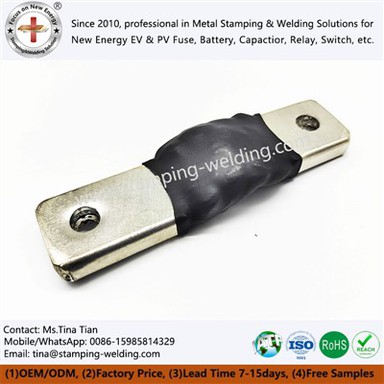
From a broader system interaction perspective, the value of copper braid soft connections lies in their role as "interface buffers." The two rigid conductors or terminals it connects may cause relative displacement due to different thermal expansion coefficients, installation tolerances or operating vibrations. Braided Copper Bus Bar Heat Shink PVC Sleeves (braided copper busbars with heat shrinkable PVC sleeves) absorb these displacements through their own flexible deformation, preventing damaging mechanical stress at rigid connections while maintaining a continuous electrical path. This cushioning effect not only protects the main electrical equipment, but also reduces the risk of overheating failure due to fretting friction at the connection points.
Its core significance is that it decouples and reintegrates the conductive function and the mechanical buffering function in a single component through specific material morphology design. Whether it is used as Flat Copper Braids for compact layouts with limited space, or as Soft Bare Copper Wires for long-span connections, the technical considerations focus on how to maintain the stability of electrical performance for a long time in a dynamic physical environment.

contact us
We focus on the R&D and manufacturing of high-quality Copper Braided Flex Connectors and are committed to providing excellent electrical connection solutions to customers around the world. With our exquisite craftsmanship, we can provide you with safe, durable and efficient customized products to ensure the stable operation of your equipment.