Continued Advancements in Busbar Heat-Shrink Insulation Technology: Heat-Shrink Tubing Enhances Insulation Protection and Operational Reliability in Power Connection Systems
Nov 14, 2026
As new energy vehicles, energy storage systems, industrial power distribution equipment, and high/low-voltage switchgear trend toward higher power density and greater compactness, busbars-critical conductors for power transmission and electrical connection-require increasingly robust insulation, environmental resistance, and long-term operational stability. Heat-shrinkable busbar tubing encapsulates conductive metal surfaces, providing electrical insulation and mechanical protection for copper or aluminum busbars and their various connection points. This helps mitigate the risk of accidental contact between exposed conductors and improves space utilization within electrical equipment.
Heat-shrinkable insulation for busbars is typically polyolefin-based, with thermal stability and mechanical properties enhanced through processes such as radiation cross-linking. Upon heating, the tubing shrinks to conform tightly to the surface of the busbar-including complex, non-uniform geometries-creating a continuous insulating protective layer. Products are available for various voltage ratings-such as 3.6kV, 24kV, and 36kV-tailored to specific equipment voltage requirements, insulation designs, and operating environments. Selection should be based on a comprehensive evaluation of electrical performance, wall thickness, shrink ratio, and relevant industry standards, rather than relying solely on the voltage rating.
Material Composition and Performance Characteristics of Heat-Shrinkable Busbar Tubing
The performance of heat-shrinkable busbar tubing is closely linked to its base material formulation, cross-linking process, and the quality of subsequent manufacturing. Common material systems include polyolefins, EVA (ethylene-vinyl acetate), and other modified polymers, often supplemented with flame retardants, antioxidants, stabilizers, colorants, and reinforcing agents to meet specific application requirements. The precise balance of these components influences the tubing's flexibility, heat-shrinkage characteristics, aging resistance, and flame-retardant properties.
Polyolefin materials offer excellent electrical insulation and processability; cross-linking further enhances their dimensional stability under heat. EVA is frequently incorporated to adjust flexibility and processing characteristics, ensuring the tubing conforms effectively to the edges and connection points of the busbars after shrinking. Meanwhile, antioxidants and stabilizers help mitigate the degradation of material properties caused by long-term thermal-oxidative aging.
For power distribution equipment operating in complex industrial environments, heat-shrinkable tubing must be evaluated for resistance to chemical agents, moisture, ultraviolet (UV) radiation, and mechanical impact. Since material formulations vary in their performance characteristics, requirements should be defined during the procurement and design phases based on the specific operating environment; no single type of heat-shrink material should be assumed suitable for all conditions.
Application of Heat-Shrinkable Insulation for Busbars in Electrical Equipment
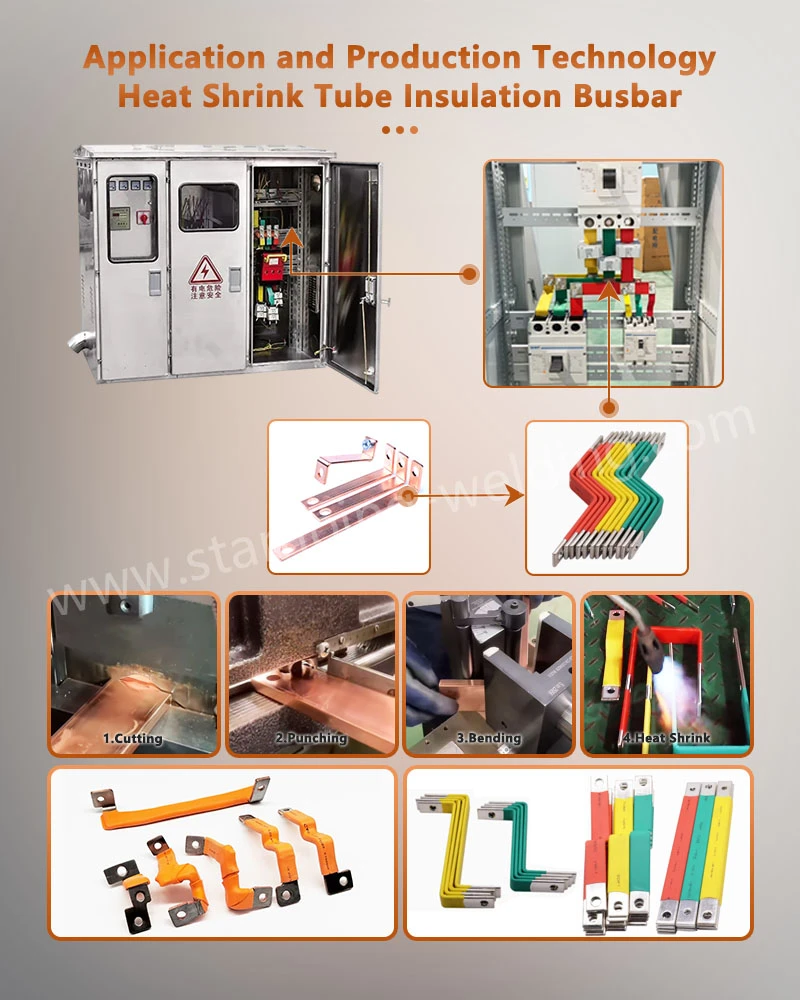
Heat-shrinkable tubing for busbars is primarily used to provide insulation and protection for exposed conductors in substations, high- and low-voltage switchgear, distribution cabinets, and industrial electrical control equipment. In conventional busbar configurations, copper or aluminum bars typically require specific electrical clearances and creepage distances. Applying heat-shrinkable insulation creates an additional barrier on the busbar surface, enabling more compact internal layouts while still meeting the equipment's insulation design requirements.
At busbar connection points, the tubing can cover portions of the conductor surface and the connection area, reducing the risk of foreign objects coming into contact with the conductors. For bolted, welded, or other metallic connections, the insulation design must also account for factors such as contact resistance, temperature rise, mechanical strength, and ease of maintenance. Heat-shrinkable materials cannot replace proper electrical clearance, creepage distance, or grounding design; they must be integrated into the overall insulation scheme of the equipment.
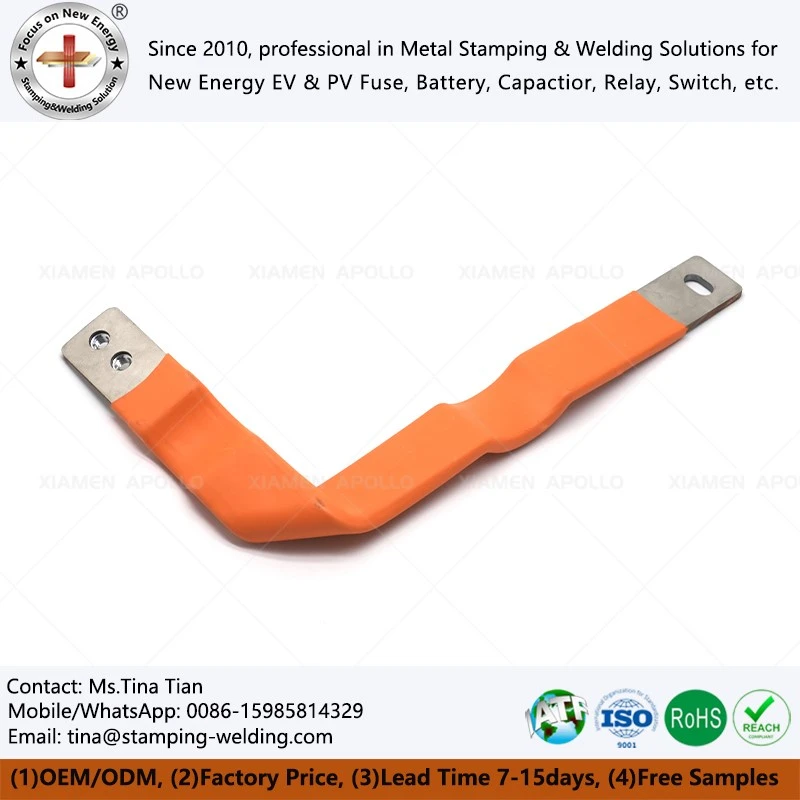
In new energy vehicles and energy storage systems, busbars facilitate current transmission between battery modules, battery clusters, power conversion units, and power distribution modules. These connection structures demand high standards for space efficiency, current-carrying capacity, insulation reliability, and vibration resistance. Depending on the specific application, engineers may utilize configurations such as copper busbars with orange heat-shrinkable tubing, which provides both an external insulation layer and visual identification for conductive components. An orange insulation layer is frequently used to identify conductors in specific high-voltage electrical systems, though specific color requirements should always adhere to the equipment's design specifications and the standards of the target market.
For flat conductive connectors in battery systems, a "flat copper battery busbar with heat-shrink tubing" integrates a current-carrying copper structure with an insulating heat-shrink layer, providing protection to the conductor surface while meeting space constraints. This type of configuration is suitable for various electrical connection scenarios in power batteries and energy storage systems; however, the actual design must account for factors such as current load, operating temperature rise, installation method, and insulation requirements.
Primary Protective Functions of Heat-Shrink Insulated Busbars
The primary function of heat-shrink tubing on a busbar is to provide electrical insulation. By covering otherwise exposed conductive surfaces, it reduces the likelihood of accidental contact-whether from maintenance tools, stray metal objects, or other conductors-thereby lowering the risk of short circuits. Within switchgear and power distribution equipment, such insulation also enhances operational safety.
A second function is to improve environmental adaptability. Power distribution equipment is often exposed to temperature fluctuations, dust, moisture, and industrial pollutants, which can negatively affect busbar surfaces and connection points. Appropriate heat-shrink tubing acts as a barrier against external contaminants, mitigating the risk of corrosion or pollution caused by direct exposure.
Nevertheless, in environments prone to condensation, salt spray, or severe corrosion, a comprehensive design approach-incorporating enclosure sealing, ventilation, heating/dehumidification, and other protective measures-is still required.
A third function is to provide mechanical protection. Heat-shrink tubing covers the edges of the busbar and certain connection areas, helping to protect the conductor surface from minor scratches or abrasions during handling, assembly, or maintenance. For complex connector geometries, the flexibility and shrinkage characteristics of the tubing will influence the quality of the final coverage.
Furthermore, insulating tubing facilitates more compact busbar arrangements. Provided that insulation coordination and safety clearance requirements are met, engineers can design the insulation structure based on the busbar's shape, installation position, and available equipment space, thereby optimizing the internal layout of switchgear. It must be emphasized, however, that the addition of heat-shrink tubing does not justify an arbitrary reduction in phase-to-phase clearance; actual spacing must still be determined in accordance with the equipment's rated voltage, insulation class, pollution degree, and relevant design standards.
Structural Design of Busbar Assemblies with Heat-Shrink Insulation
As the integration level of electrical equipment continues to rise, busbar insulation strategies have evolved from simple sleeve-based coverings toward an integrated design approach that encompasses the conductor, connection structure, and insulating material. Products can be customized based on factors such as conductor cross-section, bending angles, connection hole positioning, and available installation space, ensuring that the insulation layer aligns precisely with the busbar structure.
For instance, "Copper Busbar with Heat-Shrink Tube Insulation" focuses on providing heat-shrink protective insulation for the surface of copper busbars, while "Copper Flat/Square Busbars with PVC Heat-Shrink" emphasizes the application of PVC heat-shrink materials on flat or square-profile copper conductors. For projects requiring dimensions and connection points tailored to specific equipment layouts, "Customized Copper Busbar Connection with Heat-Shrink Tubing" allows for the integration of conductor fabrication and insulation application into a unified design process, thereby minimizing dimensional compatibility issues during final assembly.
In certain battery interconnection systems, "Heat-Shrink Sleeve Insulated Copper Busbars" are utilized for connections that require external protective insulation. In cases where both surface treatment of the conductor and insulation coverage are necessary, solutions such as "Copper Busbar with Tin-Plated Heat-Shrink Tubing" may be employed. Such designs require careful verification of the compatibility between the plating and the heat-shrink material, as well as an assessment of whether the temperatures involved in the heat-shrinking process might adversely affect the conductor's surface treatment or other functional components.
In practical applications, heat-shrink tubing is not the only method for insulating busbars. Other approaches involve the use of PVC, PET, epoxy resins, or alternative insulating materials, applied via various processes to create a protective surface layer. "Busbar with PVC Insulation" refers to busbar solutions utilizing PVC-based insulation, while "PVC Busbar Heat-Shrink Sleeves" specifically concerns the application of the PVC heat-shrink tubing itself. The optimal choice depends on a comprehensive evaluation of electrical performance, temperature resistance, flexibility, flame retardancy, and manufacturing methods.
Requirements for Insulated Busbars in New Energy Battery Interconnection Systems
New energy vehicles and energy storage systems impose increasingly stringent requirements on power interconnection systems. In power battery systems, busbars are required to connect individual cells, modules, and high-voltage power distribution components. In energy storage systems, they must facilitate stable power transmission between battery clusters, combiner units, and power conversion equipment. These connection structures must not only meet current-carrying requirements but also account for factors such as vibration, thermal cycling, spatial constraints, and long-term insulation reliability.
The design of EV battery connectors requires a holistic approach, integrating considerations for conductor materials, connection methods, insulation structures, and mounting interfaces. Copper busbars offer excellent electrical conductivity, making them suitable for a wide range of high-current applications, while heat-shrinkable insulation layers provide external protection for the conductors. For battery terminal connections, the busbar design must be tailored to the terminal dimensions, connection orientation, bolt specifications, and system current to prevent localized temperature spikes caused by insufficient contact area or uneven contact pressure.
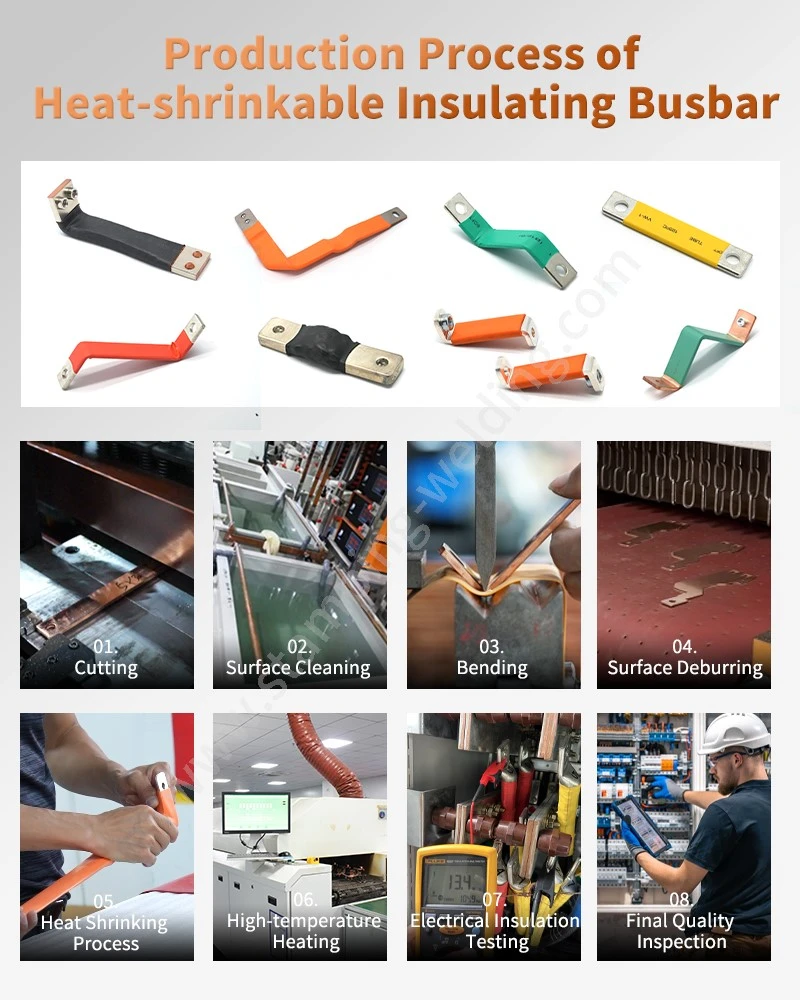
For copper busbar components that undergo bending, stamping, or welding, the application of heat-shrinkable insulation is typically performed after the primary metal fabrication and joining processes. During production, strict control must be maintained over conductor dimensions, hole-position accuracy, bending angles, weld quality, and surface cleanliness; it is essential to ensure that no burrs, sharp edges, or residual contaminants are present, as these could damage the insulation layer. For multi-segment or complex-shaped connectors, it is also necessary to verify the integrity of the heat-shrinkable tubing coverage, particularly in areas with bends or transition points.
Selection and Quality Control of Heat-Shrinkable Busbar Insulation
The selection of heat-shrinkable tubing for busbars should be based on specific operating conditions. First, it is necessary to define the system's rated voltage, insulation requirements, and conductor dimensions to determine the appropriate voltage rating, shrink ratio, and post-shrink wall thickness for the tubing. A common 2.5:1 shrink ratio indicates that the material can achieve a specific degree of radial shrinkage under defined conditions; however, final selection must also account for the busbar's maximum cross-sectional dimensions, edge geometry, and available installation space.
Furthermore, the temperature resistance and flame-retardant properties of the material must be considered. Certain heat-shrinkable materials offer specific characteristics, such as low-smoke, low-halogen, or halogen-free properties; procurement specifications should be aligned with the project's environmental and fire safety requirements. The oxygen index, vertical combustion performance, self-extinguishing capability, and long-term thermal aging characteristics of the materials should be evaluated based on test reports provided by the supplier and relevant applicable standards. Suitability for a specific piece of electrical equipment cannot be determined solely by a single parameter found in a product description.
During the production process, factors such as heat-shrink processing temperature, heating uniformity, and shrinkage duration significantly influence the final appearance and insulating performance of the tubing. Insufficient heating may lead to incomplete shrinkage in certain areas, while excessive heating can cause surface damage or alter the material's properties. Consequently, mass production requires the establishment of well-defined process parameters and inspection specifications.
For insulated busbar assemblies, it is essential to conduct dimensional checks, visual inspections, and insulation performance testing, as well as necessary verification for withstand voltage, temperature rise, and environmental adaptability. In the case of copper busbar connectors, beyond the properties of the tubing itself, one must also verify the conductor contact surfaces, connection resistance, and the reliability of the mechanical connection. Only by integrating metal fabrication, connection processes, and insulation protection into a unified quality control framework can the long-term operational requirements of power equipment be effectively met.
The Evolution Toward Customization and Integration in Busbar Insulation Assemblies
Driven by ongoing advancements in new energy vehicles, energy storage systems, power supply equipment for data centers, and industrial power distribution systems, busbar products are increasingly trending toward structural customization, integrated insulation, and precision manufacturing. Providing only standard-sized insulating tubing is no longer sufficient to address the full spectrum of complex electrical connection requirements. A growing number of engineering projects now necessitate customized solutions-encompassing copper busbar fabrication, surface treatment, insulation encapsulation, and connection architecture-tailored to specific conductor materials, cross-sectional dimensions, installation space, and electrical parameters.
For assemblies utilizing heat-shrink tubing on copper busbars, the design phase must simultaneously account for the shape of the copper busbar, the positioning of connections, and the coverage area of the heat-shrink tubing. For conductive connections requiring comprehensive insulation, a "pure solid copper busbar with heat-shrink tubing" serves as a viable design approach; however, specific material specifications and insulation schemes must be determined based on actual current, temperature rise, and electrical requirements.
In scenarios involving various connection types, a "copper busbar connector with insulated heat-shrink tubing" emphasizes the precise coordination between the connector and its insulating protective structure. Moving forward, busbar manufacturers must further enhance process synergy across precision stamping, bending, welding, surface treatment, and insulation coating. By evaluating material compatibility, manufacturing tolerances, and assembly conditions as early as the design phase, companies can reduce the risk of rework during production and improve the integration efficiency of busbar components within end-use equipment.
For engineering procurement projects requiring custom busbars, it is advisable to provide the following information during the inquiry stage: product drawings, conductor material and thickness, cross-sectional dimensions, rated current and voltage, connection methods, insulation material requirements, surface treatment specifications, and estimated annual demand. Based on these details, manufacturers can assess the feasibility of the required stamping, bending, welding, plating, and heat-shrink insulation processes, while also defining protocols for sample validation, dimensional inspection, and mass production.
An integrated approach-evaluating both the conductive structure and the insulation protection-facilitates the development of custom busbar interconnects that better meet the stringent requirements of new energy vehicles, energy storage systems, and industrial power distribution equipment.
contact us