Basic knowledge of energy storage cabinets: panoramic analysis from principles to applications
May 26, 2026
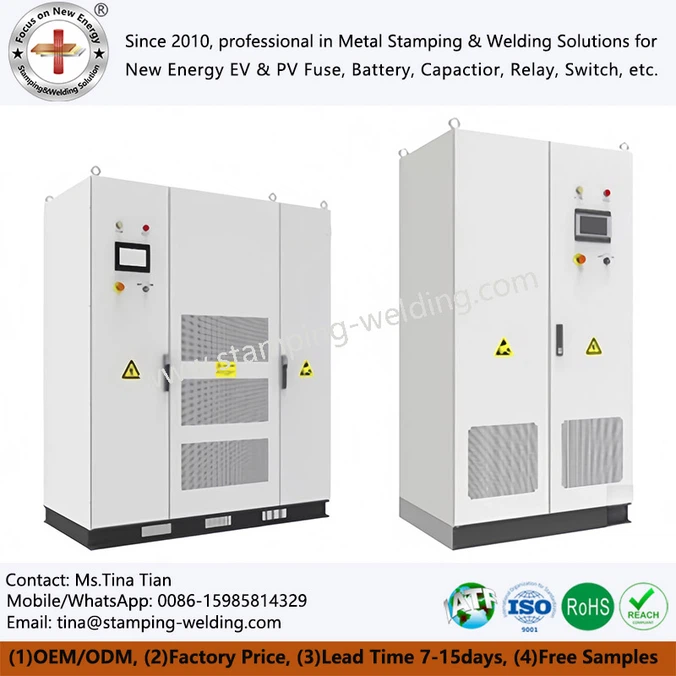
Energy storage cabinets are integrated devices used in modern power energy systems to store electrical energy and release it on demand. Its essence is to realize the time and space transfer of electrical energy through electrochemical means (mainly lithium-ion batteries). According to the actual configuration of the project, the power storage of a single energy storage cabinet can reach thousands of kilowatt hours, which is equivalent to the electricity demand of hundreds of ordinary households for a day. This large-scale energy storage characteristic enables it to play the role of a "flexible regulator" in the fields of new energy power generation and power grid peak regulation. From the perspective of technical classification, energy storage cabinets are mainly divided into two types: centralized and distributed. Centralized energy storage cabinets are mostly used in high-power scenarios such as large wind and photovoltaic farms, ground power stations or industrial parks; distributed energy storage cabinets are more suitable for industrial and commercial users, commercial complexes or microgrids and other occasions with limited space and flexible deployment.
Regardless of the type, the core value of energy storage cabinets is to solve the time mismatch problem between power supply and demand. Taking photovoltaic power generation as an example, energy storage cabinets can store the excess power generated by the photovoltaic system when the sunshine is sufficient and release it at night or when the photovoltaic output is insufficient on cloudy days, thus significantly improving the self-consumption rate and grid connection friendliness of renewable energy. In the engineering configuration of Solar Wind Energy Storage Cabinet or Solar battery storage cabinet, the energy storage cabinet is used in conjunction with photovoltaic inverters and wind power generation controllers to form an energy buffer pool on the new energy generation side, effectively smoothing the impact of intermittent power generation on the power grid.
Detailed components and system integration
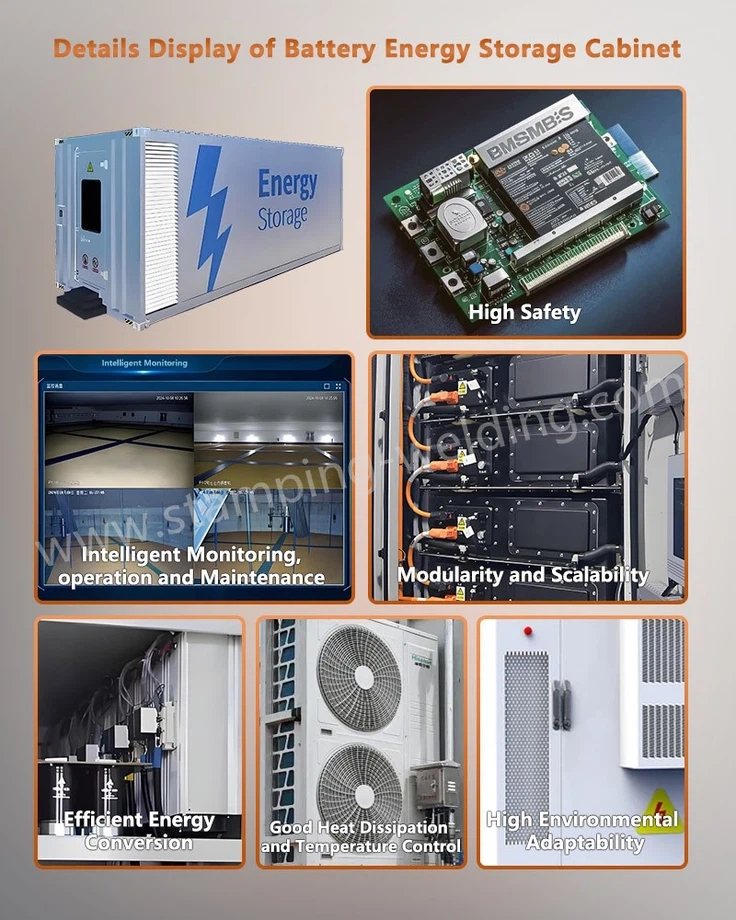
A complete energy storage cabinet system is highly integrated from four major functional modules. The energy core of the solar battery storage cabinet is composed of several battery modules connected in series and parallel. The mainstream products use modular lithium iron phosphate cells, with a cycle life of generally more than 6,000 times, and can support stable operation for more than ten years under daily charging and discharging conditions. The battery management system (BMS) is like the sensor of the nervous system. It monitors the voltage, temperature and internal resistance of each battery string in real time. It uses active balancing technology to eliminate cell differences and prevent overcharge, over-discharge and thermal runaway.
The power conversion system (PCS) is the hub of electrical energy form conversion and is responsible for bidirectional conversion between alternating current and direct current. The conversion efficiency of modern PCS has exceeded 96%, and it has grid support functions such as reactive power compensation and harmonic suppression. The energy management system (EMS) is the "brain" of the entire system. Based on load prediction, electricity price signals and battery status, it dynamically optimizes charging and discharging strategies to maximize economic benefits while ensuring power supply security. The thermal management system uses precise temperature control algorithms to ensure that the battery always operates in the optimal temperature zone of 15°C to 35°C, delaying capacity fading.
Production Working and energy management
The energy conversion of the energy storage cabinet follows the basic principle of an electrochemical reversible reaction. Taking lithium iron phosphate batteries as an example, during the charging process, lithium ions are detached from the positive electrode (lithium iron phosphate) and embedded in the negative electrode (graphite) through the electrolyte and separator; during the discharge process, lithium ions are detached from the negative electrode and returned to the positive electrode. This process of repeated insertion and extraction realizes the mutual conversion of electrical energy and chemical energy. BMS plays the role of process control. It dynamically adjusts the charge and discharge current and cut-off voltage to prevent the battery from entering an overcharge or over-discharge state, thereby significantly extending the cycle life of the battery pack.
At the level of interaction with the power grid, energy storage cabinets improve the stability and operating economy of the power system through four basic capabilities. First, frequency regulation control: The power response speed of the energy storage cabinet can reach hundreds of milliseconds, and it can quickly absorb or inject power when the grid frequency fluctuates. It has obvious advantages over the frequency regulation rate of traditional thermal power units. Second, voltage support: Through reactive power compensation or four-quadrant power operation, energy storage cabinets can improve the voltage quality of local power grids, especially suitable for long-distance feeder ends or areas with high penetration of new energy. Third, load transfer: taking advantage of the peak-valley electricity price difference to charge during low electricity prices and discharge during peak periods to achieve a significant reduction in electricity expenses. This is also the most important profit model for industrial and commercial energy storage projects. Fourth, island operation: When a power outage occurs in the upper-level power grid, the energy storage cabinet with off-grid switching capability can automatically disconnect from the grid and switch to island mode to continue supplying power to key loads until the grid is restored.
From the engineering practice of energy management, the daily operation strategy of energy storage cabinets needs to comprehensively consider the local time-of-use electricity price policy, load curve characteristics, and battery cycle life decay model. A typical industrial and commercial application scenario is: the energy storage cabinet is charged at a set power during the low valley hours at night (corresponding to lower electricity prices), and discharged for load use during the peak hours during the day (corresponding to higher electricity prices). Round-trip efficiency (AC side to AC side) determines the actual loss per kilowatt-hour of charge and discharge. Under ideal ambient temperatures, the round-trip efficiency can reach a good level, that is, for every 100 kWh of electricity absorbed from the grid, approximately 88 to 92 kWh of effective electricity can be released. The losses are mainly distributed in the power semiconductor switching losses of the PCS, the self-consumption of the BMS and auxiliary systems, and the internal resistance of the battery that is converted into heat during the charging and discharging process. In low-temperature environments or high-rate operating conditions, the efficiency will drop significantly, so the optimization of the thermal management system and charge and discharge strategies is of great significance to maintaining the average efficiency throughout the year.
Typical application scenario analysis
On the power generation side, energy storage cabinets effectively alleviate the volatility and anti-peaking characteristics of wind power, photovoltaic and other new energy power generation. Since wind power often has greater output and lower load in the latter half of the night, there is a time shift between the peak output of photovoltaics at noon and the peak load. Power stations that lack supporting energy storage are often forced to abandon wind or light. By configuring a centralized energy storage cabinet next to the booster station, this part of the originally abandoned electric energy can be stored and released during periods when the grid can accommodate it or when the load demand is high. This application not only reduces the waste of clean energy but also improves the ability of power generation companies to respond to grid dispatching instructions. At the same time, it can gain additional income by participating in the peak-shaving ancillary service market.
On the industrial and commercial power side, energy storage cabinets help users optimize their electricity bill structure. The electricity bill for industrial and commercial users consists of two parts: the electricity bill per unit of electricity and the basic electricity bill (based on transformer capacity or demand). On the one hand, energy storage cabinets reduce electricity bills through peak and valley arbitrage; on the other hand, they reduce the maximum monthly demand value by shaving peaks and filling valleys in electricity demand, thereby directly reducing basic electricity bills. For production lines or data centers that require an uninterrupted power supply, energy storage cabinets can also be used as emergency backup power sources, automatically switching to off-grid mode when the power grid fails to ensure normal shutdown or continuous operation of key equipment. In addition, after communication operators configure energy storage integrated cabinets in sites such as 5G base stations, they can not only reduce site operation electricity costs by taking advantage of the peak-to-valley price difference, but also provide backup DC power supply for communication equipment when the mains power is interrupted, improving network reliability.
contact us
We have been deeply involved in the field of smart energy for many years and are committed to providing customers with full-stack solutions from core components to full cabinet delivery. If you are looking for a high-performance, high-security pylontech us5000 cabinet to assist in project implementation, please feel free to contact our technical team for customized consultation.