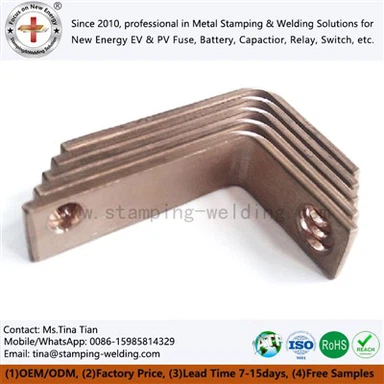
Comprehensive knowledge popularization of copper stamping parts industry
May 27, 2026
Copper stamping parts are an important branch of the metal stamping subcategory. They refer to metal parts with certain shapes, sizes and properties that are obtained by using copper and copper alloys as raw materials and separating or forming them on a press through stamping dies. Relying on copper's excellent electrical conductivity, thermal conductivity, ductility and corrosion resistance, copper stamping parts have become indispensable supporting components in many hard-core industries such as automobiles, electronics, new energy, and medical machinery. Compared with steel stamping parts, copper stamping parts have natural advantages in electrical and thermal conductivity; compared with precious metal stamping parts, copper stamping parts are more economical in cost. Therefore, copper stamping parts are often the first choice for engineering designers in situations where both conductive performance and material cost need to be considered.
From an industry perspective, the core criterion for selecting a supplier of copper stamping parts is not a single product price, but the ability to guarantee the entire chain with stable materials, reliable processes, and controllable delivery times. Custom Metal Copper Stamped products cover a wide range from simple gaskets to complex connectors, and their quality directly depends on the purity of raw materials, mold accuracy, and the reasonableness of stamping process parameters. Under the trend of miniaturization and high performance of electronic equipment, the dimensional accuracy and batch consistency requirements of copper stamping parts continue to increase, which promotes the continuous progress of stamping technology and mold manufacturing technology. At the same time, the surface treatment process of copper stamping parts (such as tin plating, nickel plating, silver plating, etc.) is also receiving increasing attention, because surface treatment directly affects the weldability, contact resistance and corrosion resistance life of the product.

Material advantages
From the perspective of general industry standards, the basic materials of copper stamping parts cover pure copper (red copper), brass, bronze, phosphor bronze, beryllium copper and other categories. Different categories of copper materials have obvious differences in hardness, ductility, conductivity, fatigue resistance and corrosion resistance, corresponding to different stamping processes and application scenarios. Pure copper (red copper) has a copper content of more than 99.9%, a conductivity of about 100% IACS, and excellent ductility, but relatively low hardness and strength. It is suitable for tensile stamping parts and occasions that require extremely high conductive properties, such as high-current connectors and grounding terminals. Brass is a copper-zinc alloy. The hardness and ductility will vary depending on the zinc content. The conductivity of brass is about 25% to 40% of pure copper, but the hardness and wear resistance are better than pure copper. It is more suitable for fine-blanking structural parts and parts that require a certain degree of mechanical strength, such as switch contact pieces and connector shells. Phosphor bronze is a copper-tin alloy with a small amount of phosphorus added. It has excellent elasticity and fatigue resistance and is widely used in various types of elastic contacts and switch springs. Beryllium copper is a copper-beryllium alloy that can achieve extremely high hardness and elastic limit after aging treatment. It is the preferred material for manufacturing high-end elastic contacts, but the cost is also relatively high.
Silver Plate Over Copper is a common surface treatment process in which the surface of copper stamping parts is first plated with nickel and then plated with silver to reduce contact resistance and improve corrosion resistance. This composite coating is widely used in high-frequency signal connectors and high-current switch contacts. The material qualification rate is one of the core quality indicators for the selection of copper stamping parts. The material qualification rate of high-quality suppliers in the industry can be stable at more than 98%, which means that only 2 out of every 100 products may have slight deviations at the material level, which is far better than the industry average. In addition to the material itself, there are also strict requirements for the surface treatment of copper stamping parts. For example, for tin-plated, nickel-plated or silver-plated copper stamping parts, the thickness of the coating must be uniform, and there must be no problems such as missing plating, blistering, peeling or discoloration, otherwise it will directly affect the conductivity or corrosion resistance.
Among new energy components used outdoors, the quality of the coating is particularly critical, because salt spray, humidity and temperature changes in the outdoor environment will accelerate the deterioration of the coating, leading to corrosion of the copper matrix. Customized Metal Stamping Copper needs to comprehensively consider the balance between electrical conductivity, mechanical strength, formability and cost when selecting materials. The higher the conductivity is not necessarily the better, but the most appropriate material grade and state must be determined based on specific application requirements. For example, for elastic terminals that require repeated bending, phosphor bronze or beryllium copper with high fatigue strength should be selected; for connecting pieces that only serve as conductive paths and do not bear large mechanical stress, pure copper or low-zinc brass can meet the requirements.

Stamping process
The core stamping processes of copper stamping parts include fine blanking, drawing, rotary cutting and drawing, continuous die stamping, etc. Different processes correspond to different product forms and accuracy requirements. The fine blanking process is a precision blanking method developed on the basis of ordinary blanking. By using a V-shaped ring gear blanking ring and a very small blanking gap, it can process copper stamping parts without burrs, flat sections, and smooth surfaces. It is very suitable for precision plug-ins, connector terminals, lead frames and other products in the electronics industry. The cross-section smoothness of fine-blanking parts can reach Ra0.8 or above, the dimensional accuracy can reach IT8 to IT9 level, and the cross-section verticality is good, and it can meet the assembly requirements without secondary processing. The stretching process can produce shell-like or cup-shaped parts with a certain depth, such as solenoid valve shells, relay shells, battery shells, etc.
The deep drawing performance of copper is better than that of stainless steel and aluminum because copper has a high elongation and moderate work hardening index, and can maintain the integrity of the material without cracking during multiple drawing processes. The rotary cutting and drawing process is a high-end technology in copper stamping parts. It combines rotational motion and linear feed motion to process drawn parts with uniform wall thickness, flat bottom and complex contours. This process requires suppliers to have ultra-precision mold design and manufacturing capabilities, as well as a deep understanding of material flow laws. Rotary cutting and stretching technology is often used in complex structural heat sinks that have high requirements for heat dissipation performance in the new energy industry, as well as special-shaped shell parts in the aerospace field. Stamping Riveting Electrical Copper Press Parts For Switch Socket is a composite process that combines stamping molding with riveting assembly, and is commonly used for conductive components in switch sockets.

future industry
The future industry trend of Custom Metal Copper Stamped is to develop in the direction of ultra-precision, lightweight, intelligent and green manufacturing. The dimensional accuracy of ultra-precision copper stamping parts will reach ±0.005mm or higher to meet the needs of 5G communications, semiconductor testing and high-end medical equipment. Lightweighting is achieved by optimizing product structure design, using high-strength copper alloys and reducing material thickness, which is particularly important for weight-sensitive fields such as aerospace and electric vehicles. Intelligentization realizes real-time monitoring of the stamping production process, quality traceability and predictive maintenance of equipment by introducing industrial robots, machine vision inspection systems, Internet of Things sensors and manufacturing execution systems. Green manufacturing is reflected in the use of lead-free copper alloys, cyanide-free electroplating processes, recyclable packaging materials and energy-saving stamping equipment to reduce the impact of the production process on the environment.
contact us
We support customizing Custom Metal Brackets Spring of different materials, sizes and surface treatments according to customer drawings, and can provide full-cycle services from sample trial production to batch delivery. You are welcome to send technical drawings or inquiry requirements to our engineering team, and we will provide you with professional process evaluation and stable supply guarantee.