Copper busbar surface treatment industry solutions: surface drawing process
Feb 23, 2025
In the power, electrical, and other industries, copper busbars are important conductive components, and their surface treatment process plays a key role in improving product performance, aesthetics, and service life. The following is an industry solution for copper busbar surface stretching and surface drawing process.

Copper busbar surface drawing process
(I) Process overview
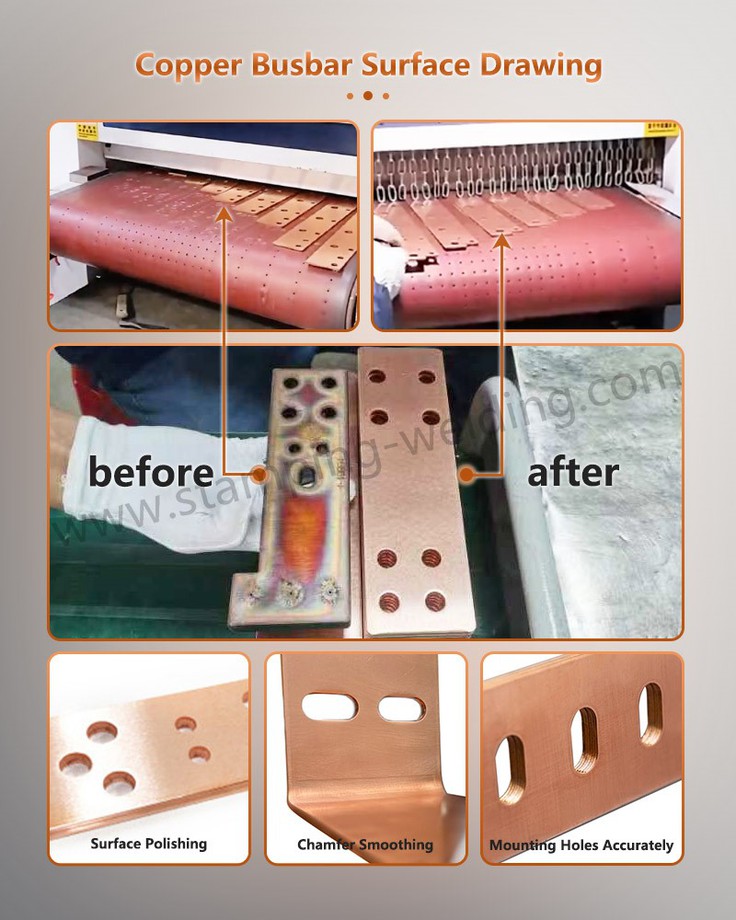
The Electrical busbar surface drawing is a surface treatment process that uses wire drawing equipment to grind the copper busbar surface through tools such as wire drawing wheels or sanding belts to form a uniform and delicate silk texture on the copper busbar surface. This process is mainly used to improve the appearance and texture of the copper busbar, and can also improve its surface wear resistance and corrosion resistance to a certain extent.
(II) Process flow
Surface cleaning: Similar to the surface drawing process, before surface drawing, the copper busbar must first be cleaned to remove oil, impurities, etc. on the surface to ensure the drawing effect.
Wire drawing operation: Select appropriate wire drawing equipment and wire drawing tools according to the required wire drawing effect and the material, thickness, and other factors of the Ground Bus Bar. Common wire drawing equipment includes flat wire drawing machines, round tube wire drawing machines, etc., and wire drawing tools include wire drawing wheels, sanding belts, etc. Fix the cleaned copper busbar on the wire drawing equipment, start the equipment, make the wire drawing tool contact the BusBar Electrical surface, and perform grinding. During the wire drawing process, it is necessary to control the parameters such as wire drawing speed, pressure, and wire drawing direction. The wire drawing speed and pressure will affect the depth and uniformity of the wire drawing texture, and the wire drawing direction determines the final wire texture direction. Generally speaking, to obtain a uniform and consistent wire drawing effect, it is necessary to keep the wire drawing speed and pressure stable and determine the wire drawing direction according to the design requirements.
Post-processing: After the wire drawing is completed, the Electrical Copper BusBar is post-processed. First, it is cleaned and neutralized to remove the residual grinding debris and acidic substances on the surface to prevent corrosion on the copper busbar surface. Then, it is dried to ensure that the copper busbar surface is dry. Finally, as needed, the copper busbar surface can be passivated or coated with protective paint to further improve its corrosion resistance and oxidation resistance.
(III) Process advantages
Improve the appearance texture: The surface wire drawing process can form a unique silk texture on the surface of the Copper Solid Bus Bar, increase the layering and texture of the product, and enhance the overall aesthetics of the product. In some electrical equipment or decorative electrical products with high requirements for appearance, the copper busbar treated with the surface wire drawing process can meet the user's demand for product beauty.
Improve wear resistance and corrosion resistance: Although the surface wire drawing process does not improve the wear resistance and corrosion resistance of the Power BusBar as much as the special anti-corrosion treatment process, to a certain extent, the silk texture can increase the surface roughness, making it difficult for the corrosive medium to adhere to the surface, thereby improving the corrosion resistance of the copper busbar. At the same time, after the wire drawing treatment, the hardness of the BusBar Copper surface will also be improved, enhancing its wear resistance.
High process flexibility: The surface wire drawing process can adjust the wire drawing parameters according to different design requirements to obtain silk textures of different thicknesses and directions to meet the diverse product design requirements.

(IV) Application scenarios
Electrical equipment housing: In the manufacture of housings for some electrical equipment, such as distribution boxes and control cabinets, to improve the appearance of the product, BusBar Electrics treated with surface brushing are often used as decorative strips or conductive parts, which not only play a conducive role but also increase the beauty of the product.
Electronic and electrical products: In some high-end electronic and electrical products, such as high-end power supplies and audio equipment, copper busbars are not only used for conductivity but also displayed as part of the product. Copper busbars treated with surface brushing can enhance the overall quality of the product and meet consumers' pursuit of high-quality products.
In summary, the surface stretching and surface brushing processes of BusBar for Siemens play an important role in improving the performance and appearance of copper busbars. In practical applications, the appropriate surface treatment process should be selected according to the specific usage scenarios and needs of the copper busbar to achieve the best product effect.
contact us