Copper flexible insulated busbar: Welding process, performance advantages, and multi field applications
Apr 28, 2026
Core welding process upgrade and quality control
The welding process of Copper flexible insulated busbar is continuously iterated and optimized, effectively avoiding defects such as virtual welding and false welding that are prone to occur in traditional brazing. At present, the mainstream adopts two advanced processes, laser welding and molecular diffusion welding, to comprehensively improve the welding quality and conductivity performance of products. Laser welding can achieve precise fusion of purple copper foil, with uniform and dense welding joints, no internal defects such as pores or slag inclusions, greatly enhancing the connection strength and ensuring smooth and stable current transmission. Molecular diffusion welding relies on a high temperature and high pressure environment to promote the mutual permeation and fusion of copper foil molecules, forming an integrated structure with excellent mechanical strength. It can evenly distribute current, reduce contact resistance, and minimize electrical energy loss.
To ensure long-term stable welding quality, the industry has established a comprehensive standardized testing system. Through multidimensional non-destructive testing methods such as ultrasonic testing and X-ray inspection, hidden dangers in welding joints are comprehensively investigated, and the welding accuracy and reliability of each Copper braided flexible connectors are strictly controlled. The overall product structure is stable, easy to maintain in the later stage, and the long-term use cost is lower.
Structural characteristics and adaptability to extreme working conditions
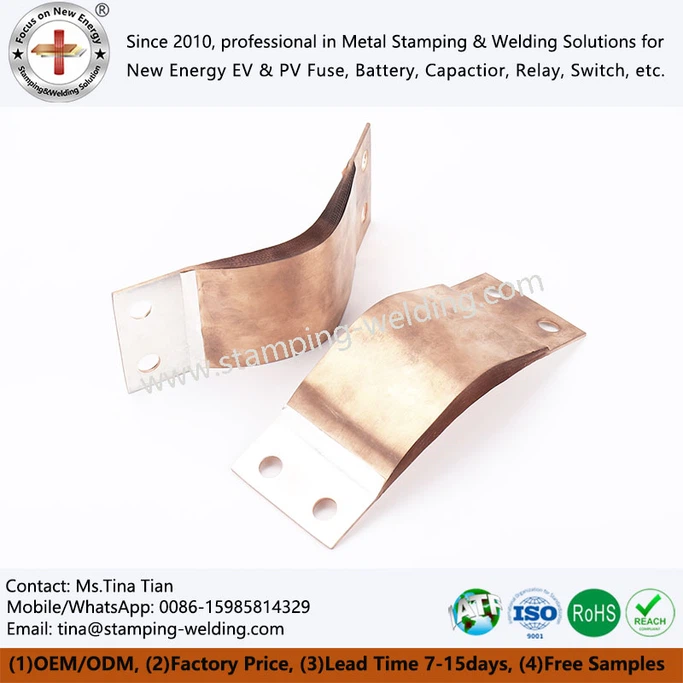
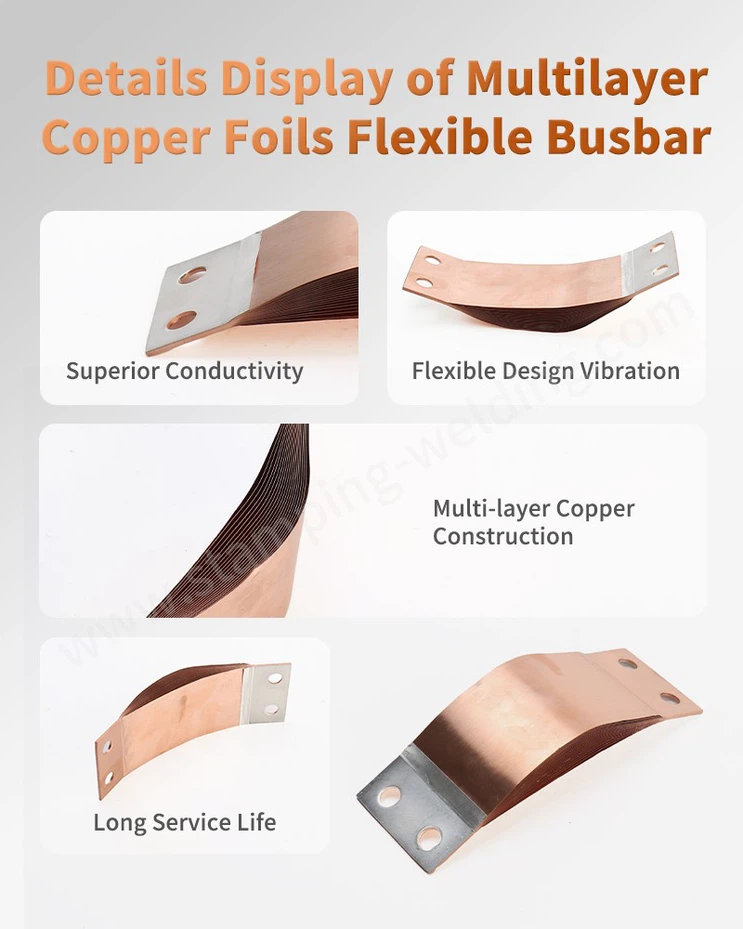
Under high current and strong vibration conditions such as rail transit traction systems and metallurgical arc furnaces, traditional hard copper bars are prone to fracture due to long-term metal fatigue, which can easily lead to equipment safety accidents. The Copper flexible insulated busbar adopts a multi-layer copper foil laminated structure, which has good damping and buffering characteristics, can effectively absorb mechanical vibrations, disperse stress loads, and avoid damage to welds and fastening points due to stress concentration.
At the same time, the multi-layer flat structure can weaken the skin effect, and under the same current carrying conditions, the conductor cross-section utilization of Flexible brained custom connectors is higher, the AC resistance is lower, the operating temperature rise control is stable, and in long-term high-frequency vibration environments, the service life and safety stability are far better than traditional hard connection solutions. It can also effectively reduce equipment operating vibration and noise.
Adaptation and customized optimization in special environmental fields
The working conditions in special fields such as ships and aerospace are complex, and they face harsh environments such as salt spray corrosion and high and low temperature alternation for a long time. At the same time, they have strict standards for equipment lightweighting and structural stability. Relying on mature surface treatment and structural optimization design, Braided copper wire can adapt to the usage requirements of diverse special scenarios. In response to the salt spray corrosion environment at sea, tin plating and silver plating anti-corrosion treatment are used to strengthen the surface protection ability, resist acid and alkali corrosion and oxidative aging, and ensure long-term continuous operation in outdoor and marine environments.
In response to the demand for lightweight aerospace, composite modified structural copper foil soft connections are gradually becoming popular, achieving weight reduction and efficiency improvement while retaining high conductivity and mechanical strength, and balancing lightweight and structural toughness. Relying on flexible customized design capabilities, Braided flexible busbars can be adapted and adjusted according to different industry equipment sizes, installation methods, and performance requirements, fully meeting the flexible conductive connection needs of special fields.

Industry development trends and comprehensive competitive advantages
At present, electrical equipment is upgrading towards high voltage, intelligence, and lightweight. The demand for flexible conductive components in the market continues to rise, and the industry value of Flexible braided copper busbars is becoming increasingly prominent. Compared with traditional hard copper connections and aluminum soft connections, copper foil soft connections have significant comprehensive advantages in conductivity, flexibility, fatigue strength, and corrosion resistance. Even though the overall cost is higher than that of aluminum soft connections, in industrial core equipment and high-voltage precision scenarios, the product's service life can reach more than fifteen years, significantly reducing equipment maintenance frequency and replacement costs, and the long-term cost-effectiveness is more prominent.
With the continuous integration of new composite materials and precision machining technologies, Braided copper bus bar heat shining PVC sleeves will achieve bidirectional development of high voltage and high current and micro precision, which can not only meet the transmission of ultra-high voltage and ultra-high current, but also adapt to the micro connection needs of precision electronics and medical equipment, promoting the coordinated development of industry standardization and customization.
contact us
If you have any selection or customization needs for Copper flexible insulated busbars, or would like to know about adaptation solutions for different working conditions, please feel free to contact us at any time. We will provide professional technical support and highly adaptable product recommendations based on your actual application scenario, helping you reduce equipment operation risks and improve efficiency.