Data Center Infrastructure Upgrades: Selection and Application Trends for Integrated Smart Server Racks
Nov 17, 2026
As enterprises advance their digital transformation and expand data center infrastructure, the deployment density of servers, switches, storage devices, and network communication systems continues to rise. Data center construction is no longer limited to the procurement of servers and network hardware; supporting infrastructure-such as power supply, cooling, environmental monitoring, and physical security-has become an essential component of infrastructure planning.
In traditional server rooms, servers are often distributed across various racks, with UPS units, air conditioning systems, and power distribution equipment deployed independently. As the number of devices grows or operational loads increase, this approach frequently leads to issues such as poor rack space utilization, uneven heat distribution, complex power management, and delayed environmental monitoring.
Against this backdrop, integrated smart racks-which combine power supply, cooling, power distribution, and environmental monitoring-are increasingly being adopted in enterprise server rooms, edge data centers, and small-to-medium-sized network facilities. Compared to conventional server racks, these integrated solutions prioritize equipment consolidation, real-time operational monitoring, and centralized management, helping to reduce the complexity of deploying data center infrastructure.
From Equipment Housing to System Integration: The Evolving Function of Server Racks
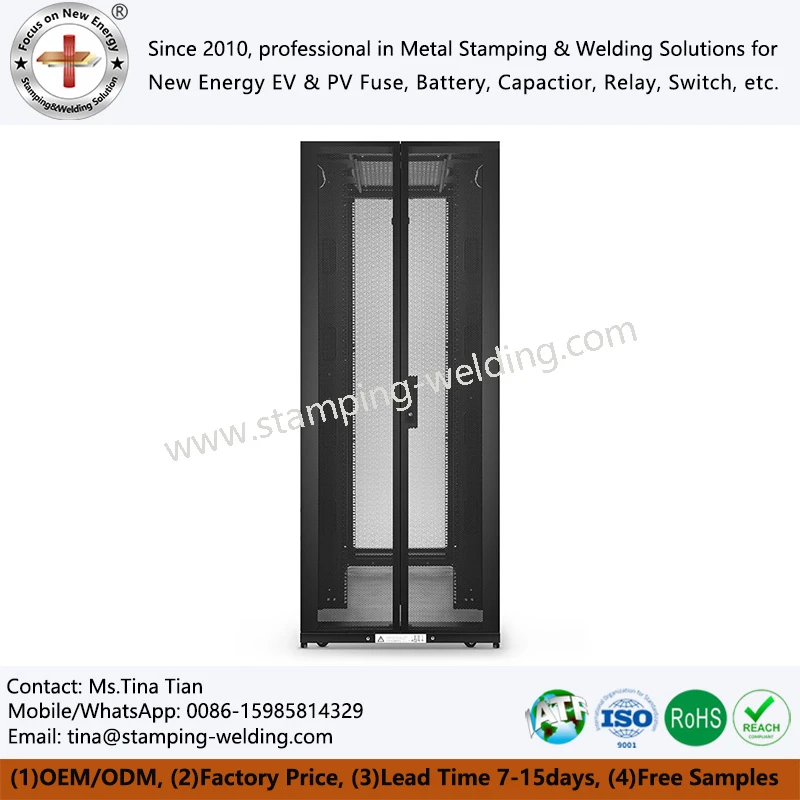
Traditionally, server racks served primarily as enclosures for mounting equipment, providing structural support, and managing cables. However, as the power density of servers increases, the physical structure of a standard rack is often no longer sufficient to meet the operational requirements of high-density equipment.
Modern server rack cabinets must not only accommodate the installation of servers and network hardware but also account for load-bearing capacity, internal spatial layout, airflow management, power distribution methods, and ease of maintenance.
Integrated smart racks typically incorporate the following functions into a standardized enclosure:
- Equipment Installation: Provides standardized mounting rails and internal space to support the deployment of servers, switches, and storage devices.
- Power Management: Integrates UPS units and Power Distribution Units (PDUs) to manage power distribution and provide backup power for the equipment housed within the rack.
- Temperature Control: Features precision cooling equipment that regulates the internal temperature based on the thermal load of the housed devices.
- Environmental Monitoring: Collects data on temperature, humidity, smoke, water leakage, and door status (via door sensors) to monitor the environment in which equipment operates.
- Security Management: Enhances physical security through electronic access control and anomaly alerts.
For enterprises lacking dedicated IT infrastructure operations staff, an integrated design reduces the need to coordinate interfaces between separate pieces of equipment, while also simplifying ongoing maintenance and troubleshooting.
It should be noted that an integrated cabinet does not imply that any equipment can be added without limitation. Actual configurations must be calculated based on factors such as the power consumption of IT equipment, cooling requirements, UPS capacity, and on-site installation conditions.
Five Key Technical Specifications for Selecting Server Cabinets
1. Cabinet Dimensions and "U" Height: Matching Installation Requirements
Server cabinets typically follow a standard 19-inch mounting structure. Equipment height is measured in "U" units, where 1U equals 44.45 mm. Common sizes include 9U, 15U, 18U, 24U, and 42U, each suited to different equipment quantities and installation environments.
9U and 15U server racks are generally used for small-scale network equipment, telecommunications gear, and edge computing deployments-ideal for offices or branch locations with limited space.
18U and 24U server racks offer more mounting space, making them suitable for small-to-medium enterprise server rooms, network distribution, and scenarios involving the integration of multiple devices.
For enterprises requiring the installation of numerous servers, switches, and storage units, the 42U cabinet remains a standard choice.
Before purchasing, verify the equipment height, mounting depth, rail dimensions, cabinet width, and internal load-bearing capacity. Additionally, measure doorways, elevators, and transport pathways in your facility to ensure the equipment can be delivered and installed without issues.
2. Cooling System: Determining Cooling Capacity Based on Thermal Load
Servers generate significant heat during continuous operation. In scenarios involving GPU servers, high-performance computing (HPC), or high-density storage, localized "hot spots" can cause equipment temperatures to rise, potentially compromising operational stability. Standard server cabinets typically rely on fans for auxiliary cooling, making them suitable for environments with relatively low thermal loads. As the power density of the equipment increases, alternative solutions-such as dedicated cooling units, side-mounted precision air conditioners, or in-row cooling systems-must be evaluated.
Integrated smart cabinets combine cooling equipment with the cabinet structure itself, optimizing airflow patterns based on the equipment's air intake direction and the exhaust path for hot air.
Key factors to verify during the selection process include:
- The total power consumption and peak load of the IT equipment housed within the cabinet;
- The rated cooling capacity of the precision air conditioning unit;
- Airflow management (cold/hot air distribution) and intake/exhaust paths;
- Operational noise levels and the space required for maintenance;
- The system's adaptability to high-temperature and high-humidity environments.
Cooling capacity should not be determined solely by the dimensions of the cabinet; rather, it must be calculated based on the actual thermal load of the equipment and the specific environmental conditions.
3. Power Supply System: UPS and PDU Configurations Must Match the Load
Servers and network equipment require a high degree of power continuity. A sudden power failure can lead to service interruptions, data anomalies, and improper equipment shutdowns.
Integrated cabinets are typically equipped with an Uninterruptible Power Supply (UPS) and Power Distribution Units (PDUs). The UPS provides backup power during utility power failures, while the PDUs distribute the incoming power to the various devices within the cabinet.
When procuring these systems, key aspects to evaluate include the UPS rated capacity, actual load ratio, battery type, backup runtime, and scalability.
For instance, a backup runtime of 10–15 minutes may serve as a preliminary design reference for some enterprise server rooms; however, the final configuration should be determined based on equipment power consumption, the startup time of any backup generators, and established safe-shutdown protocols.
For servers requiring dual-path power supply, it is also essential to verify the PDU input method, the number of output interfaces, and the A/B power feed architecture to ensure full compatibility between the power supply system and the equipment's power configuration.
4. Infrastructure Monitoring: Enabling Remote Management of the Server Environment
With the growing number of unattended server rooms and edge data centers, environmental monitoring has become an essential supporting feature for server cabinets. An intelligent monitoring system uses sensors to collect data-such as temperature, humidity, smoke levels, water leakage, access control status, and electrical parameters (voltage and current)-and transmits this information to a centralized management platform.
When monitored parameters exceed preset thresholds, the system can issue alerts via web interfaces, mobile applications, or other configured communication channels, enabling operations and maintenance (O&M) personnel to promptly identify and assess abnormal conditions.
For network cabinets deployed at remote offices or branch locations, remote monitoring can reduce the frequency of routine manual inspections; however, it cannot entirely replace on-site maintenance and periodic equipment checks.
5. Cabinet Structure and Physical Security: Balancing Load-Bearing, Cabling, and Maintenance
The structure of a cabinet directly impacts the efficiency of equipment installation and subsequent maintenance.
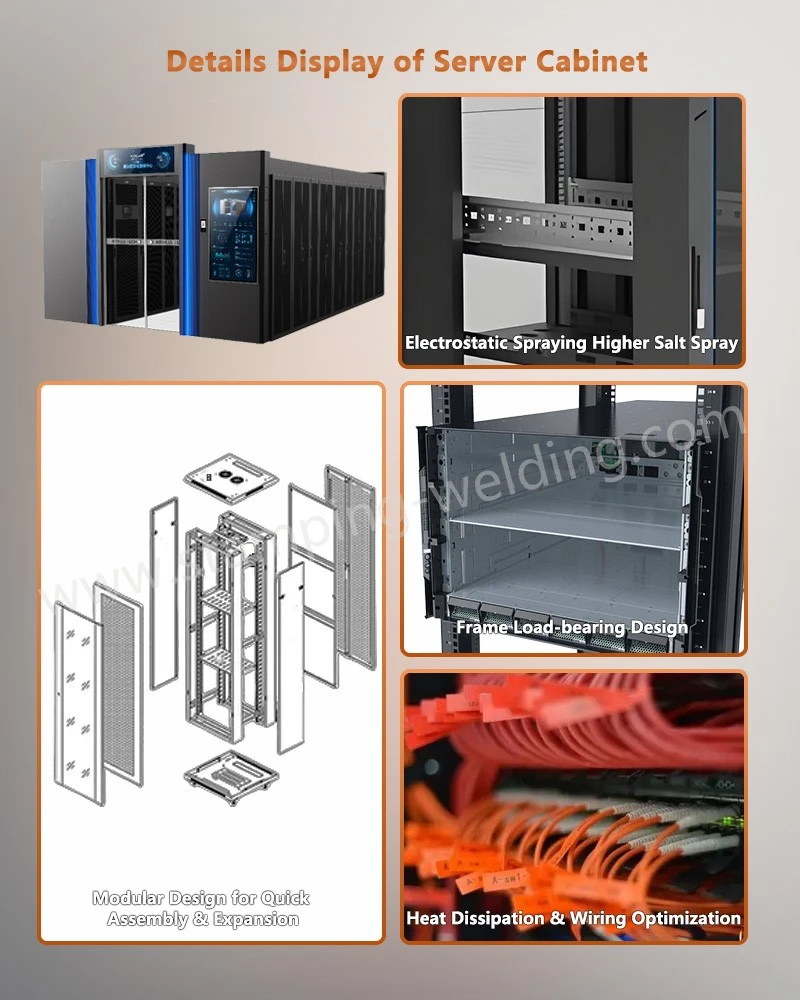
Structural design considerations include frame materials, panel thickness, static load capacity, rail mounting methods, ventilation rates for front and rear doors, and the design of removable side panels.
In environments housing a large number of servers and communication equipment, an effective cable management structure helps minimize the crossing of power and data cables, thereby facilitating easier equipment servicing.
Furthermore, access control locks, smoke detectors, and water leakage sensors can be configured based on the security requirements of the facility. For equipment requiring isolated deployment, a fully enclosed server enclosure can be used, creating a self-contained installation space defined by the cabinet doors and side panels.
Comparison of Server and Network Cabinet Solutions
Depending on equipment density, deployment environment, and O&M requirements, cabinet solutions currently available on the market can be categorized as follows:
Solution A: Integrated Intelligent Cabinet
Key Components: 42U standard cabinet, UPS, PDU, precision air conditioning, and an environmental/infrastructure monitoring system.
Operational Features:
By integrating power supply, cooling, and monitoring modules into a single cabinet, this solution reduces the need for procuring separate components and simplifies on-site installation. The internal layout can be customized based on equipment dimensions, the number of power distribution interfaces, and cooling requirements.
Typical Use Cases:
Server rooms for small and medium-sized enterprises (SMEs), branch offices, edge data centers, and locations that lack a dedicated, full-time O&M team.
Selection Considerations:
Integrating a UPS and batteries increases the total weight of the cabinet; therefore, the load-bearing capacity of the floor must be verified in advance. If the air conditioning unit or battery modules are side-mounted, additional space must be reserved for maintenance access, along with considerations for heat dissipation pathways and equipment replacement routes.
Option B: High-Density Micro-Modular Cabinets
Key Components: High-density server cabinets, in-row or overhead cooling systems, centralized UPS, and intelligent monitoring systems.
Application Features:
These systems optimize airflow through cold/hot aisle management and close-coupled cooling, making them ideal for server deployments with high power density.
Suitable Scenarios:
Large enterprise data centers, cloud computing platforms, GPU server clusters, and core mission-critical server rooms.
Selection Considerations:
A comprehensive evaluation is required, covering initial construction costs, available floor space, cooling architecture, and long-term maintenance capabilities. Due to the high level of system integration, this option places specific demands on facility planning and the professional expertise of operations and maintenance (O&M) personnel.
Option C: Specialized Constant Temperature and Humidity Cabinets
Key Components: Enclosed cabinet structures, temperature and humidity control units, environmental sensors, and security monitoring equipment.
Application Features:
Designed primarily to regulate internal temperature and humidity, these cabinets are suitable for precision equipment that requires specific environmental storage conditions.
Suitable Scenarios:
Laboratories, rooms housing precision instruments, storage areas for testing equipment, and locations where environment-sensitive equipment is deployed.
Selection Considerations:
The internal dimensions, mounting structure, and load-bearing design of these cabinets may not align with standard server equipment specifications. Before procurement, verify whether they support the installation of 19-inch rack-mount equipment.
Cabinet Selection Guidelines for Various Application Scenarios
Cabinet selection should be based on the type of equipment, deployment density, and the operating environment, rather than relying solely on "U" height or external appearance.
| Application Scenario | Recommended Cabinet Type | Key Considerations |
|---|---|---|
| Small Businesses & Offices | 9U, 15U Network Cabinets | Space utilization, cable management, basic ventilation |
| Branch Offices & Edge Rooms | 18U, 24U Cabinets | Remote monitoring, power protection, mounting depth |
| Standard Enterprise Server Rooms | 42U Server Cabinets | Load capacity, heat dissipation, UPS & PDU configuration |
| High-Density Data Centers | Micro-module Server Cabinets | Cooling capacity, airflow management, power density |
| Precision Instrument Storage | Constant Temperature & Humidity Cabinets | Temperature & humidity control, internal environmental stability |
For environments primarily housing network communication equipment, the selection of a network rack or network cabinet should focus on factors such as switch mounting depth, patch panel layout, cable management, and ventilation structure.
For locations where servers, storage devices, and computing nodes are concentrated, priority should be given to evaluating mounting depth, rail compatibility, static load capacity, and power supply capabilities.
Furthermore, the specific configuration of a data cabinet must be determined based on its intended use. Some units are designed for housing network equipment and low-voltage systems, while others must meet the more demanding requirements of servers-such as higher load capacity, advanced heat dissipation, and robust power distribution. These types are not interchangeable based solely on their external appearance.
Trends in Server Rack Manufacturing and Custom Design
As the form factors and deployment methods of data center equipment continue to evolve, the manufacturing of racks is shifting from standard sheet-metal processing toward integrated structural design and system-level solutions.
The production process for server racks typically involves sheet-metal stamping, bending, welding, surface treatment, and assembly. The rack frame must meet strict requirements for dimensional accuracy, structural integrity, and assembly consistency.
To accommodate the specific installation environments of different projects, manufacturers often customize rack dimensions-including width, depth, and height-as well as the configuration of internal mounting rails, ventilation apertures, and cable entry/exit points, based on client-provided specifications. Regarding surface treatment, powder coating can be applied to enhance the protective capabilities and visual uniformity of the cabinet exterior; the specific coating system should be selected based on the operating environment and anti-corrosion requirements.
For customized projects, structural design must also account for the following:
- Compatibility of server rails with 19-inch mounting standards;
- Static and dynamic load-bearing requirements for the cabinet;
- Ventilation structures and perforation designs for heat dissipation on the front and rear doors;
- Mounting space for UPS units, batteries, and PDUs;
- Grounding structures and the layout of cable entry/exit points;
- Requirements for equipment maintenance, modular component replacement, and transportation.
These factors collectively determine whether a cabinet is suitable for the specific IT equipment and data center infrastructure in question.
contact us
For engineering projects and bulk procurement, contact our team with your equipment dimensions, installation requirements and technical specifications to discuss customized Server Rack Cabinet solutions for your data center or network infrastructure.