Electrical Science Popularization: Analysis of the Skin Effect Principle, Hazards, and Optimization Design Schemes for Busbar with Pins for Circuit Breaker
May 02, 2026
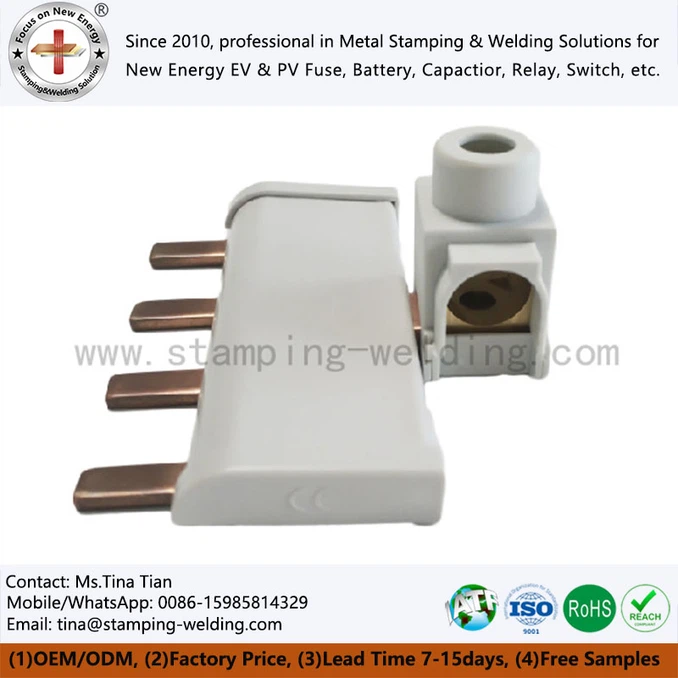
In low-voltage power distribution systems, photovoltaic combiner systems, and terminal distribution box projects, pin-type bars are core conductive components that connect circuit breakers, integrate multiple circuits, and carry power frequency AC current. Busbar with Pins for Circuit Breaker, with their advantages of convenient plug-in connection, neat wiring, and compatibility with modular cabinet installation, are widely used in various terminal power distribution systems for long-term stable operation. Under actual AC current-carrying conditions, electrical maintenance personnel often find hidden problems such as high bar temperature rise and increased reactive power loss, which are often directly related to the skin effect. The skin effect, also known as the skin tendency effect, is a natural electromagnetic physical phenomenon that occurs when alternating current passes through a metallic conductor. It directly changes the current distribution within the bar, indirectly affecting the overall current-carrying stability and service life of the Circuit Breaker BusBar.
Effect formation principle
From the perspective of fundamental electromagnetic principles, when alternating current is applied to a pin-type busbar, a dynamic alternating magnetic field is synchronously generated within the conductor. Based on the fundamental law of electromagnetic induction, this alternating magnetic field induces reverse eddy current circulation in the core region of the conductor. The direction of these eddy currents counteracts the surface current. The internal reverse eddy currents largely cancel out the central current, while the surface current is simultaneously amplified, resulting in an uneven distribution pattern where current concentrates on the surface, significantly weakening the core's current-carrying capacity. Especially when high-frequency operating conditions are continuously superimposed in power distribution sites, the interaction of the internal magnetic fields intensifies, and the current concentration phenomenon becomes increasingly prominent, becoming one of the core causes of abnormal temperature rise in the entire power distribution system.
Actual operational hazards
The persistent skin effect negatively impacts the operation of distribution busbar systems in multiple ways, creating potential safety hazards for maintenance. Current is concentrated only on the surface, effectively compressing the bar's actual effective conductive cross-sectional area. The copper core cannot function properly, significantly reducing raw material utilization. This reduction in effective cross-sectional area directly increases the equivalent internal resistance of the AC circuit. Under the same rated operating current, according to the electrical power loss formula, the bar's heat loss increases proportionally, leading to excessive internal temperature rise. This can exacerbate insulation aging and cracking, or even restrict the rated current carrying capacity of the entire Distribution Bar, triggering overload protection tripping. Operational measurement data shows that the higher the operating frequency and the greater the busbar's solid thickness, the more significant the overall negative interference. Pin-type Bus Bars for Solar, adapted for high-frequency photovoltaic power distribution scenarios, require more proactive preventative measures.

In-depth analysis of skincare products
Skin depth is commonly used in the industry as a quantitative indicator to accurately assess the degree of impact on the field. Skin depth specifically refers to the critical thickness at which the current density naturally decays from the peak value of the conductor surface to about 30% of its original value. It can be intuitively applied to the verification calculation of various copper distribution busbars. Under the conventional 60 Hz power distribution conditions, the skin depth corresponding to a standard copper conductor is approximately 8.5 mm. During engineering selection and design, as long as the thickness and diameter of the pin-type bar are controlled within the critical depth, the interference of the skin effect can be significantly reduced. If the conductor specifications far exceed the critical value, a large area of copper material in the middle is basically idle, with only the thin surface layer bearing the entire current-carrying task. This reduces both economy and safety stability, making it suitable for the standardized selection and verification standards of Distribution Box Copper Busbar.
Scientific optimization plan
Based on experience in low-voltage power distribution engineering, the industry has developed mature and reliable targeted optimization strategies to effectively mitigate the adverse effects of the skin effect. Under demanding high-current, high-frequency power distribution conditions, traditional solid, thick-section, integrated needle conductors are abandoned in favor of multi-strand ultra-fine copper braided wire structures, simultaneously increasing the overall conductive surface area and dispersing surface current pressure. The overall busbar shape is also optimized, prioritizing flat, ultra-thin cross-sections or hollow structures to improve copper utilization across the entire circuit while ensuring mechanical connection strength and compliant current-carrying area, adapting to compact breaker bar connection installation scenarios. The core design logic is to consistently increase the conductor surface area to volume ratio, adhering to the standardized design specifications for low-loss and low-temperature rise across the entire Power Electrical Busbar circuit, ensuring long-term safe and energy-efficient operation of the power distribution circuit.
Engineering Application Summary
In summary, the skin effect is a fundamental electromagnetic element that cannot be ignored in AC power distribution engineering, especially in scenarios with multiple densely packed currents connected to Busbar with Pins for Circuit Breaker. Under conditions of high frequency and high current superposition, it must be considered in the structural design from the outset. Scientifically optimizing the conductor cross-sectional shape and appropriately selecting composite braided conductors can effectively reduce heat loss, strictly control operating temperature rise, and improve the long-term stability of the entire low-voltage power distribution system.
Contact Us
If you require customized solutions to suit different operating conditions or to optimize the Busbar with Pins for Circuit Breaker, please feel free to consult our professional team for a tailored solution.