EV Fuse Ceramic Body: a key component to ensure the safety of electric travel
Apr 28, 2026
The role and value of new energy vehicle fuses
With the vigorous development of the new energy vehicle market, the safety of the power system has become a focus of concern for both consumers and manufacturers. Against this background, Ceramic Body for EV Fuse has become an indispensable component to ensure the safety of electric travel with its unique safety protection function. Fuses can quickly cut off the circuit when the current rises abnormally, preventing safety accidents such as fires and battery damage caused by short circuits or overloads.
The working principle and application scenarios of fuses
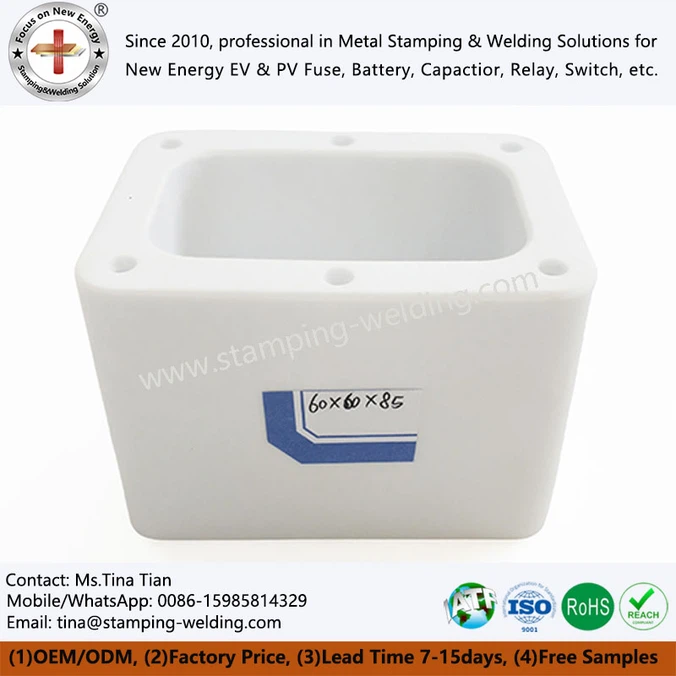
The working principle of the Ceramic Body for EV Fuse is based on the thermal effect of current. When the current flowing in the circuit exceeds the rated value set by the fuse, the fuse will melt due to heat, thus cutting off the faulty circuit. This design allows the fuse to respond to abnormal currents within milliseconds, effectively protecting key components such as batteries, motors and vehicle control systems.
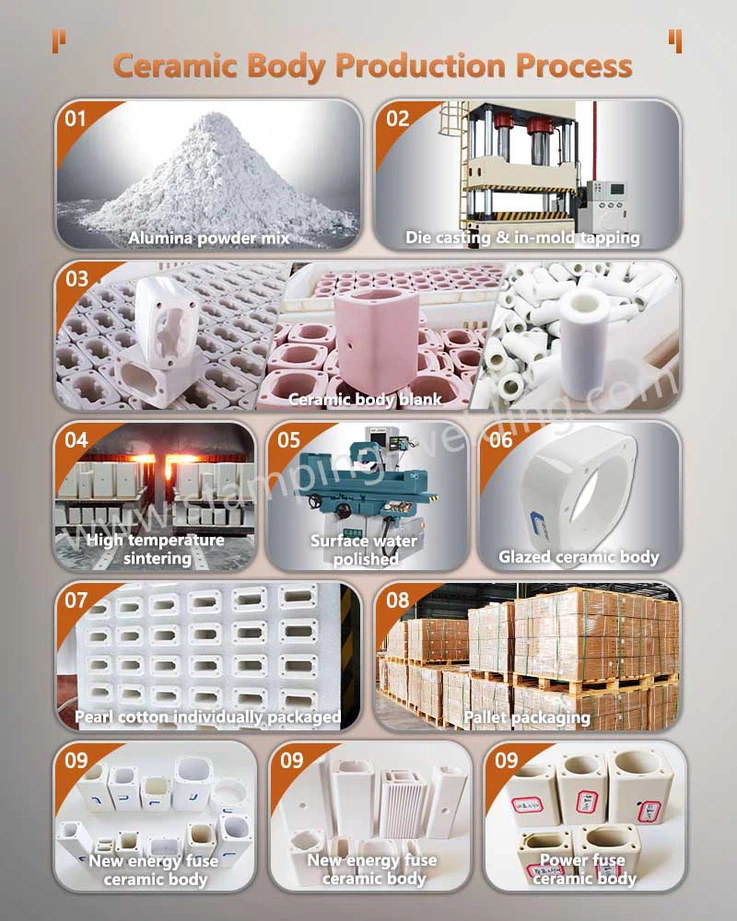
In practical applications, fuses are widely used in key circuit nodes such as battery packs, charging interfaces, and motor controllers of electric vehicles, providing a solid guarantee for the safe operation of new energy vehicles. It is worth noting that the Ceramic Body for Overload and Short Circuit Protection Fuse exhibits excellent mechanical strength and thermal shock stability when dealing with dual working conditions of overload and short circuit, and can withstand extremely high arc energy at the moment of fusing without fragmentation. From the perspective of material science, Insulating Electrical Steatite Ceramic Fused Body uses a talc ceramic formula, which has extremely low dielectric loss and excellent chemical inertness, ensuring that the performance of the fuse will not degrade during long-term use. At the same time, Ceramic Casing for Fuse Link serves as a melt packaging carrier, and its precision-molded inner cavity structure can effectively guide arc extinguishment and suppress arc flashover, thus greatly increasing the upper limit of breaking capacity.
The future development trend
With the continuous advancement of electric vehicle technology and the continued growth of market demand, Ceramic for DC Automotive Fuses are facing higher development requirements. In the future, fuses will develop towards higher performance, smaller size, and more intelligence. High-performance fuses can withstand larger currents and higher temperatures, improving the power density and cruising range of electric vehicles; miniaturized designs help reduce vehicle weight and improve energy efficiency; and intelligent fuses can integrate sensors and communication technology to achieve real-time monitoring and remote management of circuit status, further improving the safety and convenience of electric vehicles.
In this evolution path, the Ceramic Tube for EV DC Fuse has become an important technical direction to achieve a balance between miniaturization and high performance of fuses by virtue of its thin-walled and high-strength structural advantages. In response to international market access needs, Ceramic Tube for EV British Standard Fuse strictly follows the British standard certification system to ensure the compliant application of products in Commonwealth countries and regions. At the same time, the Ceramic Tube for EV BS Series, as a standardized series of products, uses a modular design concept to meet the adaptation needs of different vehicle models and platforms, effectively shortening the development cycle of the vehicle electrical system and reducing verification costs.

conclusion
To sum up, new energy vehicle fuses play a vital role in ensuring the safety of electric vehicles. With the continuous innovation of technology and the continuous promotion of market demand, fuses will continue to be upgraded and iterated to provide strong support for the vigorous development of the new energy automobile industry. In high-end application scenarios, Ceramic Body for Siemens LV HRC Fuse serves as the core ceramic component of low-voltage high-breaking capacity fuses. Its precision sintering process and strict dimensional tolerance control ensure a high degree of compatibility with the Siemens standard system.
For the field of charging infrastructure, the Ceramic Tube for EV Charger Fuse Link is specially designed for high-current protection scenarios at charging piles and battery swap stations. It can withstand frequent on-off impacts and maintain stable insulation performance. In addition, the Ceramic Body for Fuse Bolted Series adopts a bolted connection structure and is suitable for industrial application scenarios where large-section busbars are directly installed, providing reliable overcurrent protection solutions for commercial vehicles and heavy-duty electric equipment. From material selection to structural design, ceramic fuse housings are always an irreplaceable basic component in the electrical safety system of new energy vehicles.

contact us
Engineering customers with procurement needs for EV Fuse Ceramic Body are welcome to contact us. We will help your electrical safety system achieve a higher level of reliability with our professional technical capabilities and stable delivery quality.