Navigating Copper Price Fluctuations and Packaging Standards for Long-Distance Busbar Export
Oct 26, 2026
International copper busbar procurement involves two measurable risks: copper price volatility between quotation and shipment, and oxidation or mechanical deformation during ocean freight. A controlled sourcing model links material pricing to an agreed LME or SHFE copper reference, while export packaging combines VCI corrosion protection, moisture control, and load-bearing wooden crates designed for the actual geometry and mass of the copper components. Xiamen Apollo Stamping Welding Technology Co., Ltd. supports copper busbar OEM projects through material traceability, quotation transparency, production coordination, and export packaging planning.
Copper Price Volatility and Procurement Risk for Copper Busbar Sourcing from China
How LME and SHFE Copper Prices Affect Busbar Quotations
Copper accounts for a substantial proportion of the raw material cost of a copper busbar. For large-volume procurement, even a small change in the copper benchmark can materially affect the final contract value.
Two commonly referenced copper markets are the London Metal Exchange (LME) and the Shanghai Futures Exchange (SHFE). Their prices are not directly interchangeable because they use different trading currencies, delivery locations, contract specifications, and tax treatments.
| Pricing Variable | LME Reference | SHFE Reference | Procurement Implication |
| Trading currency | USD | CNY | Exchange-rate exposure must be defined |
| Market context | International non-ferrous metals market | Domestic Chinese futures market | Reference should match the agreed purchasing model |
| Delivery basis | Contract-specific | Contract-specific | Exchange quotations are not automatically factory-gate prices |
| Tax treatment | Depends on transaction structure | Domestic pricing commonly incorporates VAT conventions | Specify tax-inclusive or tax-exclusive treatment |
| Settlement date | Agreed quotation or pricing date | Agreed quotation or pricing date | Fix the applicable pricing window in the contract |
A copper busbar quotation should distinguish the metal benchmark from the conversion cost. The latter may include cutting, stamping, bending, drilling, deburring, plating, insulation, inspection, and packaging.
A Formula-Based Copper Busbar Quotation Model
For a transparent quotation, the material component can be linked to an agreed copper reference price.
This simplified equation assumes that the reference price is expressed per metric tonne and that the remaining costs use the same currency and unit basis. Actual quotations must separately define material yield, scrap recovery, alloy premiums, applicable taxes, and any agreed processing surcharges.
For example, if a component contains 2.0 kg of copper and the agreed benchmark changes by USD 500 per tonne, the direct benchmark-related material cost changes by approximately USD 1.00 per part before yield, scrap recovery, premiums, and other contractual adjustments.
This calculation gives procurement teams a traceable basis for reviewing price revisions rather than accepting unexplained percentage increases.
LME Copper Hedging and Contractual Price Fixing
A factory supplying copper busbars may use purchasing contracts, inventory planning, or financial hedging to manage copper price exposure. These mechanisms have different effects and should not be treated as equivalent.
| Risk Management Method | Operating Mechanism | Main Limitation |
| Fixed-price quotation | Agrees on a price for a defined validity period | Factory bears the agreed exposure if input costs rise |
| Benchmark-linked quotation | Adjusts material cost using an agreed reference and date | Buyer remains exposed to market movements |
| Physical copper purchasing | Secures material through supplier orders or inventory | Ties up working capital and introduces inventory risk |
| Futures hedging | Uses exchange-traded contracts to offset some price exposure | Basis risk, margin requirements, and imperfect quantity matching |
| Staggered purchasing | Splits material procurement across agreed dates | Does not eliminate price volatility |
A workable LME Copper Hedging Busbar Factory model requires agreement on the benchmark, quotation date, conversion formula, currency exchange rate, pricing validity, and treatment of unused or excess material.
A hedge does not automatically guarantee a lower copper price. Its purpose is to reduce defined price exposure, and the outcome depends on hedge coverage, timing, and the relationship between the physical purchase price and the financial benchmark.
Contract Controls for Large-Volume Copper Busbar Procurement
Before production release, the purchase agreement should define:
Benchmark: LME or SHFE reference, including the relevant contract or published price basis.
Pricing window: A fixed date, agreed average period, or other documented fixing mechanism.
Currency: USD, CNY, or another agreed settlement currency.
Material specification: Copper grade, conductivity requirement, dimensions, temper, and applicable standard.
Conversion costs: Separate charges for stamping, CNC machining, bending, welding, plating, and insulation.
Adjustment mechanism: A documented formula for benchmark movements, scrap recovery, and alloy premiums.
Validity and release: Quotation expiry, forecast quantity, order quantity, and material purchase authorization.
For electrical busbars, copper grade and conductivity must be specified independently of the market price. C1100 or another agreed copper grade should be selected according to electrical, mechanical, forming, and joining requirements rather than price alone.
Request Free DFM Evaluation & Quote
VCI Corrosion Protection and Moisture Control for Ocean Freight
Why Copper Busbars Require Multilayer Export Packaging
Copper busbars can develop surface discoloration, oxide films, water marks, and packaging-related contamination during long-distance transportation. Risk increases when cargo experiences repeated temperature changes, high relative humidity, condensation, salt-laden air, or prolonged storage before installation.
Copper does not rust like carbon steel, but oxidation and surface contamination can affect appearance, contact preparation, plating adhesion, and downstream joining processes.
Packaging selection must account for the destination climate, shipping duration, storage conditions, surface finish, and whether the busbar is bare copper, plated copper, or insulated copper.
| Exposure Condition | Potential Failure Mode | Packaging Control |
| High humidity | Surface oxidation and water marks | Moisture barrier with suitable desiccant |
| Temperature cycling | Condensation inside the package | Controlled sealing and moisture management |
| Salt contamination | Corrosion and surface deposits | Clean packing environment and protective barrier |
| Direct contact between parts | Scratches and abrasion | Individual separators and non-abrasive interleaves |
| Long storage duration | Barrier degradation or desiccant saturation | Defined storage limits and inspection requirements |
No packaging method can guarantee zero oxidation under every shipping condition. The protection system should be qualified for the expected transportation route and storage duration.
VCI Film, Vacuum Packaging, and Desiccants: Selection by Surface Requirement
Volatile corrosion inhibitor (VCI) packaging releases corrosion-inhibiting compounds into the enclosed environment. Its suitability depends on the inhibitor chemistry, packaging compatibility, part material, and subsequent manufacturing requirements.
Vacuum packaging reduces the amount of air inside a sealed package, but vacuum alone does not remove all moisture or prevent condensation after temperature changes. Desiccants adsorb moisture within their rated capacity, provided the package has adequate barrier properties and the desiccant quantity is correctly calculated.
| Packaging Method | Main Function | Engineering Limitation |
| VCI film or bag | Inhibits corrosion under qualified conditions | Must be compatible with copper, plating, and downstream processing |
| Moisture-barrier bag | Limits moisture ingress | Performance depends on film barrier properties and seal integrity |
| Vacuum sealing | Reduces enclosed air volume | Does not independently guarantee low residual moisture |
| Desiccant | Adsorbs moisture inside the package | Capacity depends on type, quantity, humidity, and duration |
| Individual separators | Prevents metal-to-metal abrasion | Must not introduce fibers, adhesive residue, or corrosive contaminants |
For plated busbars, packaging materials should be checked for compatibility with tin, nickel, or silver finishes. For components scheduled for laser welding, resistance welding, or brazing, protective materials must not leave residues that interfere with joint formation.
Desiccant Quantity and Moisture-Budget Calculation
Desiccant selection should be based on the package's moisture load, not an arbitrary number of sachets.
The selected desiccant capacity must exceed the calculated moisture load by an appropriate safety margin. The calculation should use the desiccant manufacturer's rated adsorption capacity under relevant temperature and humidity conditions.
Practical controls include:
Drying components when the process specification requires it.
Packing in a controlled, clean environment.
Selecting moisture-barrier materials with documented water-vapor transmission properties.
Sealing packages immediately after loading the desiccant.
Recording packing date, batch number, and package identification.
Defining inspection and repacking criteria after prolonged storage or transit delays.
Request Export Packaging Assessment
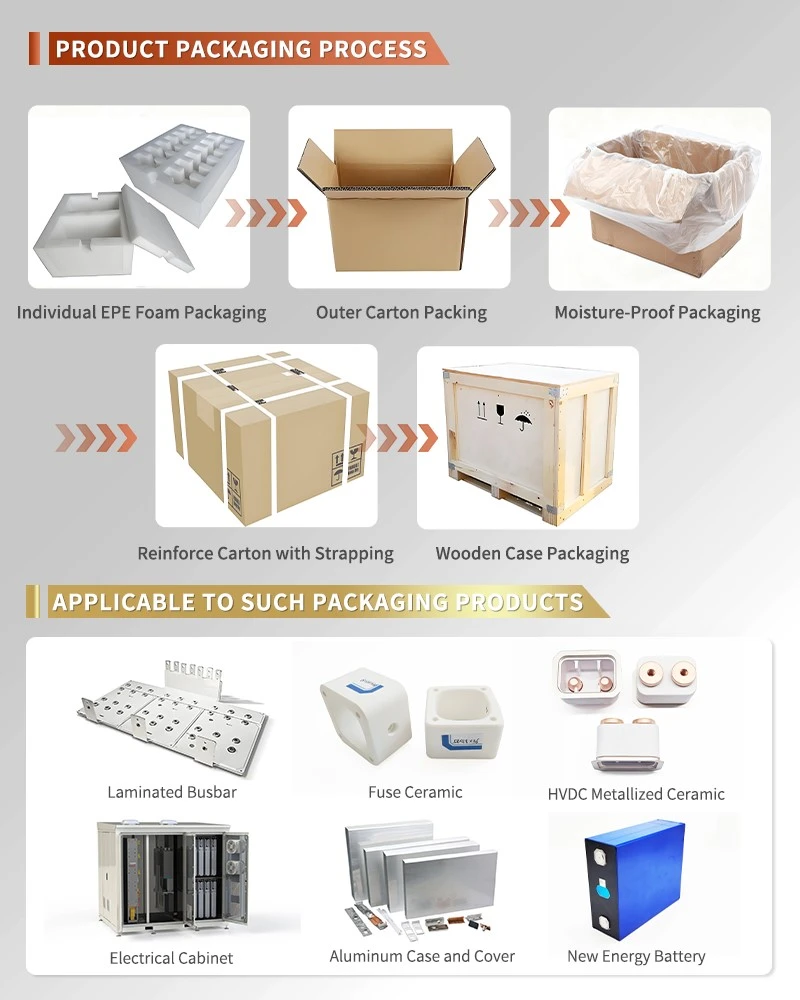
ISPM 15 Wooden Crates and Structural Protection for Heavy Copper Busbars
Crate Design for Long, Heavy, or Asymmetrical Busbars
Long copper busbars and complex bent assemblies create packaging challenges that ordinary cartons cannot reliably address. Copper has a density of approximately 8,960 kg/m³, so even a relatively small cross-section can produce a substantial package mass when component length and shipment quantity increase.
Packaging design must account for gross mass, center of gravity, support spacing, lifting points, transport acceleration, stacking loads, and the fragility of plated or insulated surfaces.
For irregular assemblies, the packaging should support the component at defined structural locations rather than applying pressure to unsupported bends or terminal features.
| Design Variable | Engineering Requirement | Validation Method |
| Gross package mass | Include products, separators, crate, and accessories | Weighing and shipping records |
| Center of gravity | Prevent unstable lifting or tilting | Load distribution review |
| Support spacing | Limit bending and vibration-induced movement | Deflection assessment |
| Internal restraint | Prevent sliding and metal-to-metal impact | Transport simulation or shipment inspection |
| Lifting structure | Match forklift pockets or approved lifting points | Handling trial |
| Stacking strength | Withstand defined warehouse and container loads | Structural calculation or load test |
For copper busbars with tight flatness or positional requirements, supports should be positioned near suitable load-bearing regions. Restraints must not deform thin sections or damage insulation and plating.
ISPM 15 Compliance for International Wooden Packaging
ISPM 15 is the International Standards for Phytosanitary Measures No. 15, which governs wood packaging material used in international trade. It applies to qualifying solid-wood packaging, including many wooden crates and pallets, subject to the applicable rules and exemptions.
Heat-treated or otherwise approved wood packaging must meet the applicable treatment, marking, and regulatory requirements. The familiar HT marking identifies heat treatment; it should not be described as proof that every shipment or every component meets all destination-country import requirements.
Export packing controls should include:
Verification that regulated solid-wood packaging carries a valid, legible ISPM 15 mark.
Selection of crate dimensions compatible with container and handling limits.
Protection against water ingress through suitable covers and package design.
Internal bracing to restrain the load without crushing the products.
Clear gross weight, net weight, lifting, and handling labels where required.
Verification of destination-specific import, carrier, and customer requirements.
ISPM 15 addresses pest-risk management for regulated wood packaging. It does not certify crate strength, corrosion resistance, shock protection, or moisture-barrier performance. Those functions require separate engineering controls.
Vibration and Shock Protection for Precision Copper Components
During road transport, port handling, container loading, and ocean freight, a busbar package may encounter repeated vibration, impact, and load redistribution.
Potential damage includes:
Permanent bending of unsupported copper sections.
Scratches on silver-, nickel-, or tin-plated surfaces.
Cracking or separation of insulating layers.
Deformation of precision terminal bends.
Damage to welded or brazed joints.
Packaging qualification should therefore consider the complete transport chain. Where the customer specifies an applicable distribution test protocol, the crate and internal restraints should be evaluated against that protocol rather than relying solely on visual inspection.
For long-distance export, the packing drawing should identify support positions, restraint locations, prohibited contact areas, and unpacking instructions. This reduces the risk of damage caused by incorrect handling after delivery.
Export Quality Assurance, Traceability, and Delivery Risk Control
Incoming Copper Inspection and Batch Traceability
Reliable international supply starts with the incoming material record. A busbar batch should be traceable to the material specification and the inspection records required by the purchase order.
Depending on the program, quality documentation may include:
Copper grade and supplier material certificate.
Electrical conductivity or resistivity test results where specified.
Thickness, width, length, and flatness inspection.
Surface-finish and plating-thickness records.
Dimensional inspection of formed and drilled features.
Packaging inspection and shipment identification.
For C1100 copper, conductivity requirements should be defined against the applicable material standard and temper. A statement of 100% IACS should only be used when supported by the relevant test method, material condition, and acceptance criteria; it should not be assumed for every copper alloy or finished component.
Manufacturing Process Control for Export Busbar Orders
A copper busbar may undergo multiple operations before packing. Dimensional variation introduced during cutting, punching, bending, joining, or plating can affect the fit of the final electrical assembly.
| Process | Key Quality Characteristic | Inspection Approach |
| Cutting and blanking | Length and edge condition | Dimensional inspection and burr assessment |
| Punching and drilling | Hole diameter and position | Gauging or CMM inspection as specified |
| CNC or press bending | Bend angle and positional accuracy | Fixture inspection and dimensional measurement |
| Laser welding or brazing | Joint integrity and geometry | Visual, dimensional, and specified destructive or nondestructive testing |
| Plating | Coating thickness and coverage | X-ray fluorescence or another agreed method |
| Insulation application | Coverage, adhesion, and dielectric performance | Visual and specified electrical testing |
| Final packing | Restraint, cleanliness, and identification | Packing checklist and photographic records |
Tolerance requirements such as ±0.01mm must be assigned to specific features where the manufacturing process and inspection method can demonstrate capability. They should not be presented as a universal tolerance for every busbar feature.
Shipment Release and International Delivery Documentation
A shipment-release checklist should link the approved product revision, quantity, inspection status, packaging configuration, and transport documents.
Typical records include:
Purchase order and approved drawing revision.
Final inspection report.
Material certificates when contractually required.
Packing list with net and gross weights.
Commercial invoice and applicable export documents.
Package identification and traceability records.
Photographs of internal protection and sealed crates.
Incoterms® rules should be identified by the selected rule and named place, together with the applicable edition. This clarifies the allocation of transportation costs, delivery obligations, and risk transfer between seller and buyer.
No packaging system can eliminate every delay caused by customs inspections, port congestion, carrier schedules, or exceptional weather. A controlled release process makes the shipment's technical condition and documentation verifiable before dispatch.
Copper Busbar Material Selection and Export Packaging Matrix
Copper Grade and Surface Treatment Selection
The packaging method should be selected only after the material and finish are confirmed. Bare copper, plated copper, and insulated laminated busbars have different requirements for surface contact, moisture protection, and mechanical restraint.
| Component Type | Typical Material or Finish | Packaging Priority |
| Bare electrical busbar | C1100 or other specified copper grade | Oxidation control and scratch prevention |
| Tin-plated busbar | Copper with tin coating | Coating protection and moisture control |
| Nickel-plated busbar | Copper with nickel coating | Surface cleanliness and abrasion prevention |
| Silver-plated busbar | Copper with silver coating | Tarnish management and non-abrasive separation |
| Laminated busbar | Copper conductors with PET, epoxy, or other specified insulation | Edge protection, bend protection, and dielectric integrity |
| Flexible copper connector | Foil stack or braided copper | Avoiding compression, strand damage, and permanent deformation |
Packaging compatibility should be confirmed for the specific plating chemistry, insulation material, and downstream assembly process. VCI products must not be assumed compatible with all finishes or electrical contact interfaces without supplier confirmation.
Matching Packaging Configuration to Shipment Risk
| Shipment Profile | Recommended Design Considerations |
| Small machined busbars | Individual separators, moisture barrier, and suitable carton |
| High-volume plated busbars | Batch segregation, non-abrasive interleaves, and moisture control |
| Long rigid copper bars | Rigid supports, bending restraint, and handling access |
| Complex bent busbars | Geometry-specific fixtures and protection for terminal features |
| Insulated laminated busbars | Controlled clamping pressure, edge protection, and insulation verification |
| Heavy export consignments | Load-bearing crate design, gross-weight verification, and documented lifting points |
The final packaging specification should define package quantity, component orientation, separator material, allowable movement, moisture-control configuration, stacking limits, and inspection requirements. This information should be approved before mass shipment, especially when packaging dimensions affect container utilization or freight cost.
Apollo's Copper Busbar Export Coordination and OEM Supply Model
Transparent Pricing and Production Planning
For international buyers sourcing copper busbars from China, price transparency depends on separating copper benchmark exposure from manufacturing conversion costs. Apollo can structure quotations around agreed material specifications, processing operations, surface treatment, packaging, and shipping requirements.
A procurement review should confirm:
The reference copper price and fixing date.
The material grade and net component weight.
Scrap and material-yield assumptions.
Manufacturing and finishing operations.
Packaging configuration and destination requirements.
Order quantity, production lead time, and shipment release criteria.
Any copper inventory, price-fixing, or hedging arrangement should be confirmed against the specific order. Buyers should not assume that a factory's material reserves automatically lock the price for future orders.
Export Packaging Validation Before Shipment
Apollo's export packaging planning should begin with the approved part drawing and shipment profile, not with a standard crate selected after production.
For long or heavy busbars, the engineering review should cover component orientation, support spacing, terminal protection, moisture-barrier selection, and handling requirements. For plated or insulated products, it should also address surface compatibility and post-shipment inspection.
A documented packaging specification helps purchasing, quality, logistics, and receiving teams work from the same acceptance criteria. For repeat orders, retaining the approved packing configuration and shipment records provides a basis for investigating transit damage and improving packaging performance.
Frequently Asked Questions
1. How can international buyers reduce copper price risk when sourcing busbars from China?
Agree on an LME or SHFE reference, pricing date, currency, conversion charges, and adjustment formula before order release. For long-term programs, assess fixed-price contracts, staged material purchases, or hedging arrangements according to the buyer's risk policy.
2. Is VCI packaging sufficient to prevent copper busbar oxidation during ocean freight?
Not in every environment. VCI packaging should be selected according to material finish and validated conditions. Moisture-barrier bags, suitable desiccants, clean packing, and sealed crates may be required for long transit and humid storage.
3. Does an ISPM 15 mark guarantee that a wooden export crate can protect heavy copper busbars?
No. ISPM 15 addresses regulated wood packaging and pest-risk treatment. Crate strength, internal supports, moisture protection, vibration resistance, and safe lifting must be evaluated separately against the shipment's mass and geometry.
contact us