How to Select End Cap and Contact Welding Components for High-Voltage EV Fuses
Aug 04, 2026
High-voltage EV fuses operate under continuous current loads, short-circuit impact, thermal cycling, and vehicle vibration. The reliability of the fuse does not only depend on the fuse element, but also on the electrical connection performance of the End Cap and Contact Welding Components. Proper material selection, welding process control, and dimensional accuracy directly affect contact resistance, temperature rise, and long-term safety performance.
For EV fuse manufacturers and battery system suppliers, selecting a suitable end cap and contact assembly requires evaluation of copper material conductivity, welding strength, corrosion resistance, and production consistency.
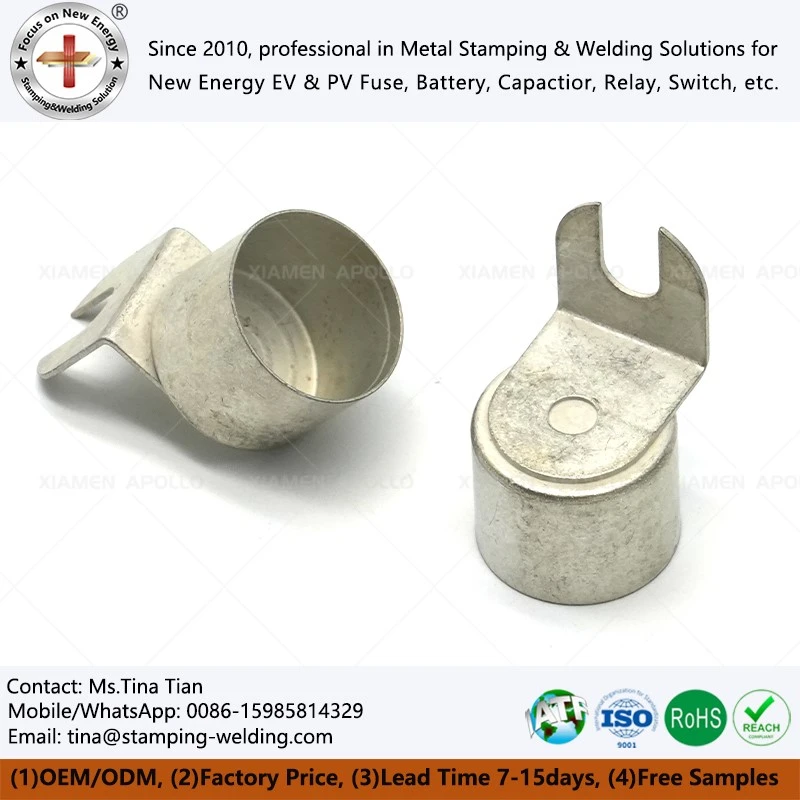
End Cap and Contact Components in High-Voltage EV Fuse Structures
In high-voltage battery systems, EV fuses are commonly installed in battery packs, power distribution units (PDU), motor controllers, and charging systems. These applications typically involve 400V and 800V electrical platforms, with continuous current ratings exceeding 200A and short-circuit currents reaching several thousand amperes.
The end cap and contact components form the main current transmission path between the fuse element and external electrical connection points. Any increase in contact resistance will generate additional heat according to:
P = I²R
For example, when a 300A current passes through a connection area with an additional resistance of 0.5mΩ:
P = 300² × 0.0005 = 45W
This additional heat can accelerate copper oxidation, reduce contact pressure, increase resistance further, and affect the fuse operating characteristics.
Therefore, high-quality End Cap and Contact Welding Components need to maintain stable electrical conductivity, mechanical strength, and thermal performance during the complete vehicle lifetime.
Material Selection: Copper Contact vs Brass Contact for EV Fuse Applications
The selection of contact material directly influences electrical losses and mechanical reliability. Copper alloys are widely used because they provide a balance between conductivity, strength, and manufacturing performance.
| Material | Conductivity |
|
Typical Application |
|---|---|---|---|
| C1100 Pure Copper | ≥100% IACS | Excellent conductivity, lower hardness | High current fuse contacts and end caps |
| C1020 Oxygen-Free Copper | High conductivity | Improved purity and thermal performance | High reliability EV fuse components |
| C2680 Brass | Lower conductivity | Higher strength and wear resistance | Structural terminals and fixing parts |
For high-current EV fuse applications, C1100 pure copper is commonly selected for current-carrying areas because its low electrical resistance reduces heat generation.
Brass materials such as C2680 are sometimes used where mechanical strength and forming performance are more important, especially in terminal structures requiring higher rigidity.
Surface treatments such as silver plating or tin plating can further improve oxidation resistance and maintain stable electrical contact performance.

Welding Process Selection for End Cap and Contact Assembly
The connection method between the end cap, contact, and fuse element determines the electrical and mechanical reliability of the assembly.
Common joining processes include resistance welding, brazing, and laser welding.
| Welding Process | Main Characteristics |
|---|---|
| Resistance Welding | Fast production cycle, localized heating, suitable for automation |
| Silver Brazing | High electrical conductivity and strong metallurgical bonding |
| Laser Welding | Precise heat control and small heat affected zone |
Resistance welding is widely used for mass production because it provides repeatable connection strength with controlled welding current, electrode pressure, and welding time.
For high-voltage EV fuses, welding parameters must be carefully controlled. Excessive welding energy may cause deformation or damage to surrounding components, while insufficient energy may result in weak bonding and increased contact resistance.

Key Manufacturing Controls for EV Fuse Welding Components
The production consistency of end cap and contact assemblies depends on multiple manufacturing processes, including stamping, surface treatment, welding, and inspection.
Precision stamping is used to control component geometry, contact shape, and assembly position. Typical dimensional tolerances may require control within ±0.01mm depending on the fuse design.
Surface preparation before welding is also important. Oil contamination, oxide layers, or uneven surfaces may affect welding stability and create defects such as weak joints or inconsistent electrical resistance.
Manufacturers should establish process controls covering:
- Raw material inspection
- Progressive stamping accuracy
- Welding parameter monitoring
- Plating thickness verification
- Electrical resistance testing
- Dimensional inspection by CMM equipment
These controls ensure that every batch of Fuse Cap and Contact Resistance Welding components maintains consistent performance.
Reliability Testing Requirements for High-Voltage EV Fuse Components
Automotive fuse components must withstand long-term electrical and environmental stress. Before mass production, engineering teams typically evaluate:
| Test Item | Purpose |
|---|---|
| Contact Resistance Test | Verify electrical connection stability |
| Temperature Rise Test | Confirm thermal performance under rated current |
| Pull Strength Test | Evaluate welding mechanical strength |
| Salt Spray Test | Verify corrosion resistance |
For automotive supply chains, production validation commonly follows quality systems such as IATF 16949 and PPAP requirements.
A reliable supplier should provide traceability from copper material selection, stamping process, welding parameters, surface treatment, and final inspection results.
How to Evaluate an End Cap and Contact Welding Component Supplier?
When selecting a supplier for high-voltage EV fuse components, purchasing and engineering teams should evaluate more than product price.
Key evaluation factors include:
Material capability:
The supplier should understand copper grades, brass alloys, plating requirements, and electrical performance requirements.
Manufacturing capability:
Stable production requires precision stamping equipment, welding process control, automated inspection, and batch consistency management.
Validation capability:
Suppliers should have testing capability for contact resistance, temperature rise, welding strength, and dimensional accuracy.
A supplier with integrated stamping, welding, and inspection capabilities can reduce development risks and improve supply chain stability for EV fuse applications.

Conclusion
Selecting suitable End Cap and Contact Welding Components for High-Voltage EV Fuses requires a balance between electrical conductivity, mechanical reliability, welding performance, and production consistency.
For EV battery systems and high-voltage power applications, copper material selection, controlled welding processes, and strict quality verification determine the long-term reliability of fuse assemblies.
Engineering-focused component suppliers with experience in precision metal stamping, resistance welding, and copper contact manufacturing can provide stable solutions for automotive and energy storage applications.
Frequently Asked Questions
Q: What welding process is commonly used for high-voltage EV fuse contact assemblies?
A: Resistance welding is widely used for EV fuse contact assemblies because it provides fast production, stable bonding strength, and suitability for automated manufacturing.
Q: How can contact resistance be reduced in EV fuse end cap components?
A: Low-resistance copper materials, proper surface plating, controlled welding parameters, and accurate assembly dimensions help reduce contact resistance.
Q: What quality tests are required for EV fuse welding components?
A: Common tests include contact resistance testing, temperature rise testing, pull strength testing, thermal cycling, and corrosion resistance testing.
Contact Us
If you are seeking a reliable supply solution for high-voltage End Cap and Contact Welding Components, our engineering team offers support with material selection, welding process evaluation, and OEM volume manufacturing.