


High-Reliability Conductive Component Selection Guide: Understanding Fog Tin-plated Copper End Caps
Feb 28, 2026
Fog Tin-plated Copper End Caps, also known as matte-plated copper caps, are metal end caps made from high-purity T2 copper as the base material. After stamping, a layer of matte tin is electroplated onto the surface. Their core value lies in the scientific combination of the base material and the plating, achieving both excellent electrical performance and physical protection, making them suitable for various harsh working environments. As an important category of plated end caps, they, along with bright-tin-plated copper end caps and silver-plated copper end caps, constitute the mainstream copper end cap selection system. Among them, the matte-plated type is particularly widely used in high-reliability scenarios due to its unique performance advantages.

Selection criteria: Material and coating characteristics
The core prerequisite for selection is clearly defining the characteristics of the material and plating, which is crucial for matching the application scenario. Regarding the substrate, matte tin-plated copper caps use industrial pure T2 copper, which possesses extremely high conductivity (second only to silver) and good processing ductility. Its melting point is approximately 1083℃, and its relative density is 8.9 g/cm³, meeting the requirements for high current transmission and adapting to the structural requirements of various components such as fuses and connectors. It is also one of the core substrate choices for copper caps. In terms of the plating, matte tin differs significantly from common bright tin. Its surface is milky white and matte, with larger crystal grains and lower internal stress, effectively inhibiting tin whisker growth and reducing the risk of short circuits in electronic circuits from the source. This characteristic distinguishes it from bright tin-plated products, making it a core selection point for high-safety-requirement scenarios.
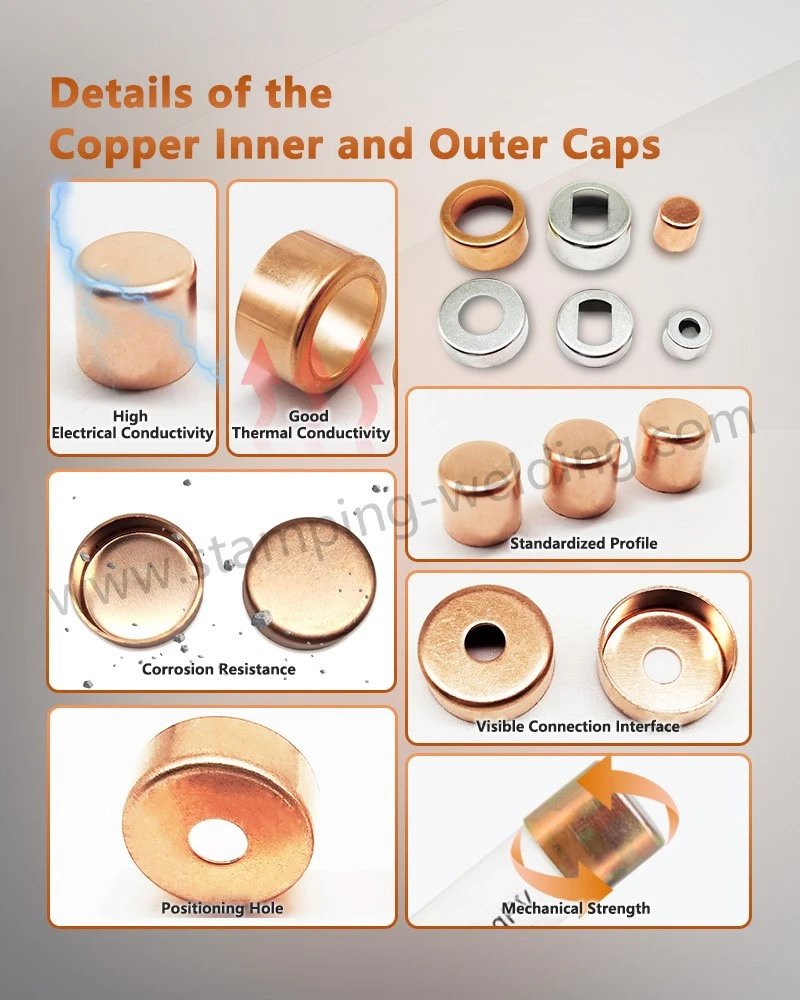
Core function: Basis for selection and adaptation
Clearly defining the core function of a product is crucial for selecting the right model. The four core functions of matte tin-plated copper caps directly determine their applicable scenarios: First, oxidation prevention: the tin layer effectively isolates the copper substrate from air and moisture, preventing the formation of "verdigris" or black spots, extending the lifespan of components-a fundamental protection requirement for all plated end caps. Second, improved solderability: tin's low melting point makes soldering the copper cap to wires and circuit boards easier, reducing the risk of cold solder joints and making it suitable for various soldering and assembly scenarios. Third, reduced contact resistance: the matte tin layer fills in the microscopic unevenness of the copper surface, providing a more stable contact surface and maintaining low and stable contact resistance, ensuring stable current transmission-especially critical in high-current scenarios. Fourth, enhanced corrosion resistance: the tin layer possesses excellent resistance to salt spray and acid/alkali corrosion, performing significantly better in salt spray tests than bare copper, making it suitable for complex working conditions such as humidity and corrosion.

Scenario Selection: Focus on Key Areas
Precise selection based on application scenarios is key to maximizing product performance. Fog Tin-plated Copper End Caps are widely used in fields with extremely high reliability requirements, and the selection priorities differ depending on the scenario: In the field of power fuses, as the end cap of a fuse, it is compatible with Copper Cap for Bussmann series Class H(K) Fuses, responsible for carrying large currents and ensuring long-term connection stability; conductivity and temperature resistance are key considerations during selection. In the field of new energy vehicles, it is used as a connecting conductive component in high-voltage distribution boxes (PDUs) and battery management systems (BMS). As a type of Copper Outer Cap, products with uniform plating and strong vibration resistance should be prioritized to adapt to the complex operating conditions of vehicles in motion. In the field of electronic components, it can be used as a conductive component in capacitor packaging terminals and electrical connectors; solderability and size compatibility must be considered during selection. In some scenarios, it can be used in conjunction with Copper Slip Caps to improve assembly flexibility.

Contact Us
If you have any needs such as selection consultation or specification customization for Fog Tin-plated Copper End Caps, please feel free to contact us for professional solutions.


