In-depth technical expertise: Analysis of the core value of Copper Strip Stamping in precision manufacturing
Feb 12, 2026
In the field of precision manufacturing, Copper Strip Stamping, as a key cold forming technology, has become an important support for the mass production of core components in electronics, electrical appliances, and new energy vehicles, thanks to its precise application of the properties of copper. Compared with traditional processing techniques, copper strip stamped, with its advantages of high efficiency, precision, and stability, is suitable for the manufacturing needs of various precision components. Its core process flow and product characteristics determine the performance and quality of downstream components, making it a key technology of concern in the industry.

Core Process: Three Key Steps for Efficient Mass Production
The core competitiveness of copper strip stamping lies in its standardized and efficient process flow. Currently, the industry generally adopts the highly automated progressive die stamping method, which enables precise control and mass production throughout the entire process. Specifically, it consists of three core links. First, in the uncoiling and feeding stage, the coiled copper strip is mounted on an uncoiler and leveled by a leveling machine to ensure a smooth surface and uniform thickness. It is then precisely fed into the press, laying the foundation for subsequent stamped. This stage directly affects the dimensional accuracy of the stamped copper strip products. Second, in the stamping stage, multiple processes such as punching, blanking, bending, and deep drawing are completed simultaneously in a multi-station progressive die. Precise die positioning enables one-time forming of the component shape, effectively improving production efficiency and ensuring the consistency of Copper Pressed Components. Finally, in the post-processing stage, the stamped components undergo degreasing, cleaning, and deburring according to downstream application requirements to remove surface impurities and burrs. Some products also employ surface electroplating processes such as Silver Plate Over Copper to enhance the weldability and corrosion resistance of the components, further optimizing product performance and extending service life.

Product Features: Precision and Diverse Adaptability
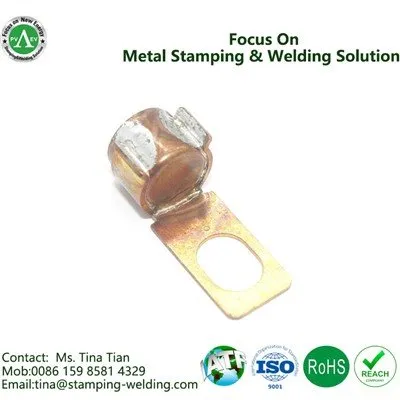
Beyond its mature manufacturing process, the core characteristics of Stamping Copper Sheet products align with the high-end demands of various downstream sectors, exhibiting precision, diversification, and strong adaptability. In terms of precision, copper strip stamped, relying on automated equipment and precise molds, enables mass production of micro-sized parts with dimensional errors controlled within a reasonable range, meeting the stringent requirements of the electronics, electrical, and semiconductor industries for precision components. Regarding material compatibility, depending on the downstream application scenarios, copper stamped can utilize different types of copper and copper alloy strips. Pure copper has the highest conductivity and is the core raw material for Red Copper Stamping Parts, widely used in products such as busbars and lead frames. Brass (copper-zinc alloy) boasts high strength and good machinability, making it suitable for connector terminals and decorative parts. Phosphor bronze/beryllium copper offers excellent elasticity, making it the preferred material for high-performance contact springs such as Customized Electrical Stamped Copper Springs, achieving precise matching between products and application scenarios.

Future Outlook: Process Optimization and Deep Application
Industry experts say that the continuous optimization of Copper Strip Stamping technology is mainly focused on improving the precision of the process and iteratively upgrading product features. In the future, with the continuous progress of mold technology and automation technology, stamped will further break through the processing bottlenecks of ultra-thin and ultra-precision parts, optimize the process flow, improve product performance, and at the same time, combine with the changing needs of downstream fields to launch more highly adaptable customized products, promote the deep application of stamped parts technology in the field of precision manufacturing, and provide strong support for the technological upgrading of downstream industries.
Contact Us
In practical engineering applications, the technical principles of Copper Strip Stamping described above ultimately need to be implemented through specific product design. Different combinations of structures and materials will directly affect the long-term stability of the system.