Industry application and technical specifications of Braided tin coated copper flexible wire connectors
Mar 26, 2026
Structural characteristics and core performance
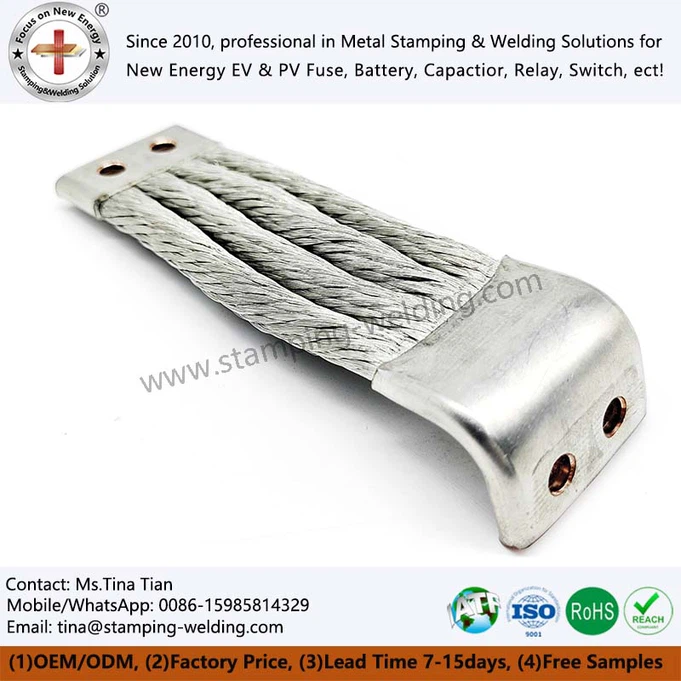
Braided tin coated copper flexible wire connectors use high-purity oxygen free copper wire as the core substrate, forming a tightly ordered mesh structure through precision weaving technology. The surface is covered with a uniform and dense tin layer through professional tin plating technology. The copper wire weaving structure endows the Braided flexible copper busbar connector with high flexibility and fatigue resistance, enabling multi angle bending and twisting, and adapting to complex installation spaces and frequent mechanical motion scenarios; The tin plating layer can effectively isolate the corrosion of copper substrate by air, moisture, and corrosive media, prevent oxidation and sulfurization, while reducing contact resistance and ensuring long-term stable conductivity.
The core performance of the Braided copper flexible wire connector is excellent overall conductivity, with the copper substrate ensuring basic conductivity efficiency and the tin plating layer further optimizing contact stability; Outstanding antioxidant and anti-corrosion capabilities, suitable for special environments such as humidity and corrosion; Having both flexibility and fatigue resistance, it can withstand repeated bending and vibration without easily breaking, making it suitable for dynamic connection scenarios; Stable mechanical performance, multi strand copper wire weaving provides good tensile strength and can withstand certain mechanical stresses; Strong temperature adaptability, with a working temperature range covering -40 ℃ to+150 ℃, meeting the needs of conventional industrial environments.
Key points of production process and technology
The manufacturing process of Braided tin coated copper flexible wire connectors requires strict control over each process step, including raw material screening, precision weaving, tin plating treatment, and finished product testing. In the stage of raw material selection, high-purity copper wire is used as the substrate, and the diameter of the copper wire is usually controlled in the range of 0.05mm to 0.2mm. Precise selection is made according to product specifications to ensure basic conductivity from the source. In the weaving process, multiple strands of copper wire are woven into specific densities and angles using professional weaving equipment. The weaving density is controlled within a reasonable range, balancing product flexibility and mechanical strength. Common weaving structures can be adjusted according to application needs to adapt to different installation scenarios.
Tin plating treatment is a key step in improving product performance. Before tin plating, the Flexible braided copper busbar strip needs to be strictly cleaned and activated to thoroughly remove surface oxides, oil stains, and impurities, ensuring a tight bond between the tin layer and the copper substrate, meeting adhesion standards, and avoiding problems such as coating detachment and unevenness. The finished product stage requires full process testing, with a focus on verifying core indicators such as weaving density, tin plating thickness, resistance value, mechanical strength, etc., to ensure that the product meets industry standards and operational requirements.

Core application areas
Copper braided flexible connectors play an irreplaceable role in multiple industrial fields due to their stable conductivity, excellent corrosion and vibration resistance. In the field of power equipment, it is widely used for grounding connections, phase to phase flexible connections of transformers, circuit breakers, switchgear and other equipment, as well as conductive connections of moving parts of high-voltage switchgear. It can ensure reliable power supply and adapt to mechanical movements during equipment operation, reducing the risk of connection failures.
In the field of new energy, its adaptability is particularly prominent. The electrical connections between components of photovoltaic power generation systems, as well as the conductive connections between wind turbine generators and inverters, all rely on the weather resistance and vibration resistance of Flexible braided custom connectors, which can effectively resist harsh outdoor environments such as high temperature, humidity, and corrosion, ensuring the stable operation of the system. In the field of rail transit, this material is used for flexible connection between pantographs and train bodies in high-speed trains and subways, meeting the requirements of high conductivity, fatigue resistance, and fire resistance, and adapting to the continuous vibration and spatial changes during high-speed train operation.
In the field of communication equipment, Braided copper wire can be used for electrical connections in scenarios such as base station antennas and microwave equipment. Its stable contact performance ensures stable signal transmission; In the field of industrial automation, it is suitable for dynamic electrical connections of robots, CNC machine tools and other equipment, maintaining stable conductivity during continuous movement and avoiding the impact of connection failure on equipment operation; In the aerospace field, aircraft electrical systems have extremely high requirements for connection reliability and lightweight. Tin plated braided flexible connections have become one of the core connection materials due to their stable performance.

Selection and usage guidelines
Scientific selection and standardized use of Flat copper braid flexible are key to ensuring stable operation of electrical systems. In terms of electrical parameter matching, it is necessary to select the appropriate conductor cross-sectional area based on the working current. Under normal operating conditions, it is recommended that the current density not exceed 3A/mm ² (continuous operation) and 5A/mm ² (short-term operation) to avoid overload heating caused by insufficient cross-sectional area. In terms of mechanical adaptation requirements, it is necessary to select the appropriate weaving structure and product length based on the installation space size and equipment movement mode (bending, twisting, stretching), to ensure installation fit and interference free movement.
In terms of adapting to environmental conditions, products with a tin plating thickness of ≥ 8 μ m should be selected for corrosive environments such as beaches and chemical plants to further enhance their protective performance. If necessary, surface treatment solutions with higher protection levels can be used. In terms of standardized connection methods, common crimping terminals, bolt connections, and other methods must be strictly followed to ensure that the contact resistance of the connection parts meets the standard. At the same time, the tightness and integrity of the coating of the connection parts should be regularly checked, and problems such as looseness and oxidation should be dealt with in a timely manner to ensure the long-term stable operation of Flex Connector.
With the continuous advancement of industrial manufacturing technology, Copper braided flexible busbars will further optimize processes, improve performance, and develop towards higher stability, longer lifespan, and greater environmental friendliness. Users should consider the specific needs of their own application scenarios when making purchases, fully understand the product's technical parameters and adaptability, choose suppliers with professional qualifications and rich experience, and ensure product quality and practical application effects.
contact us
If you have any requirements for the selection, specification customization, or bulk procurement of Braided tin coated copper flexible wire connectors, please feel free to contact us at any time for professional technical support and accurate quotations. We can provide adaptation solutions based on your working conditions and scenarios to assist in the stable operation of your project. We sincerely invite you to inquire and discuss cooperation.