Principle, characteristics, and industry application analysis of PVC heat shrinkable sleeves for busbar
Apr 30, 2026
Principles of Materials and Structural Characteristics
PVC heat shrinkable sleeves for busbars are commonly used polymer insulation and protective materials in the electrical field. Based on polyolefins, they are formed into a three-dimensional network molecular structure through irradiation or chemical cross-linking processes, giving the material a unique shape memory effect. At room temperature, pipes can be expanded and shaped. When heated to a specific temperature threshold, the molecular chains will retract and recover, tightly covering the surface of the soft busbar and various conductive components along the radial direction, forming a sealed and complete insulation protective layer.
The principle of shrinkage is derived from the orientation, crystallization, and thermal rebound characteristics of polymer molecular chains. The level of crosslinking process directly determines the shrinkage ratio, mechanical strength, temperature resistance, and service life of the pipe. Flame retardants, colorants, and other additives can also be added to the formula to meet the usage requirements of different Heat shrink tube polyolefin busbars.

Electrical performance and physical process characteristics
The core value of PVC heat shrinkable sleeves for busbars lies in their excellent electrical insulation protection capabilities. After molding, they can build a stable insulation barrier, effectively isolate live conductors, avoid safety hazards such as phase to phase short circuits and foreign object contact leakage, and have a dielectric strength of several thousand volts per millimeter. Some formulations also have additional properties such as arc resistance and anti leakage tracing, making them suitable for complex electrical operating environments.
In terms of physical properties, the conventional shrinkage ratio in the industry is concentrated in the range of 2:1 to 4:1. A high shrinkage ratio can adapt to more specifications of irregular Heat shrink tubing busbars, but requires higher uniformity of the tube wall; When subjected to thermal shrinkage, slight deformation will occur in the axial direction. Reasonable dimensional allowance should be reserved for engineering installation. Qualified products should have a smooth surface without wrinkles and uniform wall thickness after shrinkage, ensuring insulation reliability from a structural perspective. The installation method is simple and convenient, and can be uniformly heated by a hot air gun or a constant temperature oven. Under normal working conditions, the coating can be completed in a short time, and only the uniformity of heating temperature needs to be controlled to avoid material aging and deterioration caused by local high temperature.
Environmental adaptability and engineering application scenarios
PVC insulation busbar pipes have excellent wide temperature weather resistance and environmental adaptability. The standard specifications are suitable for temperatures ranging from -40 ℃ to 125 ℃, and the specially modified formula can withstand high temperature conditions above 150 ℃. At the same time, it has good oil resistance, solvent resistance, moisture and corrosion resistance, and can resist long-term external stress erosion such as temperature cycling, mechanical vibration, and industrial corrosive media. It can maintain sealing integrity and insulation stability even after long-term use.
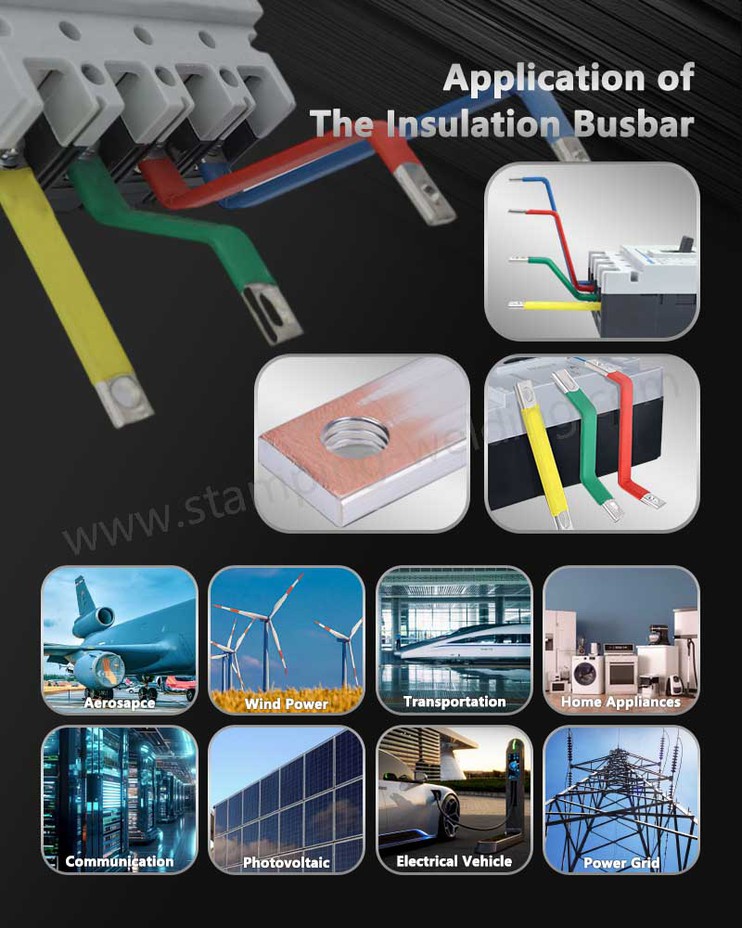
In engineering applications, it is mainly used for insulation protection of exposed connection parts of power equipment and busbar systems, and can flexibly adapt to various irregular Busbar sleeves insulation structures such as L-type and Z-type; Adapting to the trend of miniaturization and integration of electrical equipment, compared to traditional insulation tapes and hard sleeves, it is easier to install, has stronger adhesion, and longer protection. It can also distinguish phase functions through standardized colors, making it easier for later operation and maintenance identification.
Selection matching points and industry development trends
In actual engineering selection, Busbar inserting tubing needs to be matched with the material, external dimensions, and working environment of the soft busbar. Customized formulas and specifications can be supported for irregular structures and special working conditions. Batch industrial production often uses tunnel type constant temperature heating equipment, while on-site operation and maintenance are adapted to portable heating tools, balancing production efficiency and on-site construction flexibility.
The future development of the industry will continue to upgrade around low shrinkage temperature, high elasticity adaptation, halogen-free environmental protection and flame retardancy. Through material formulation and cross-linking process optimization, the comprehensive performance of aging resistance, high and low temperature resistance, and mechanical fatigue resistance will be further improved. With the iteration of electrical equipment towards high-density, high reliability, and green, Busbar insulation sheet has become an indispensable core supporting material in the electrical insulation protection system due to its flexible wrapping characteristics and stable insulation performance.
contact us
If you need to know the selection parameters and adaptation solutions for different specifications of PVC heat shrinkable sleeves for busbars, please feel free to consult and negotiate at any time. We can provide professional technical support and customized supply services to meet the insulation matching needs of various power and new energy projects.