Sheet metal brass stamping machining material selection and process key points
Mar 19, 2026
Core elements of brass alloy material selection
Brass alloys are mainly composed of copper and zinc, with some grades containing trace elements such as tin. Different ratios directly affect stamping and performance. When selecting the appropriate brass material for the stamping process of Sheet metal brass stamping, key factors such as cost, machinability, surface treatment adaptability, weldability, bending performance, tensile strength, usage scenarios, and forming ductility should be comprehensively considered.
The cost needs to match the project budget range, and the machinability directly determines the production difficulty and efficiency. The surface treatment characteristics affect the subsequent appearance and functional upgrades of Brass sheet metal stamping. Weldability is related to the reliability of multi-component connections, and the bending grade and tensile strength determine the structural stability of the material during molding and service. The final material selection must meet the actual application requirements, taking into account specific properties such as conductivity, wear resistance, and corrosion resistance.

Common forming processes for Sheet metal brass stamping
The Relay pin brass terminal processes the sheet metal into the target structure through various forming processes, including punching, punching, deep drawing, and bending. Punching is used to cut out the overall shape of the part, and it is necessary to strictly control the distance between the hole diameter and the hole edge to reduce burrs and avoid secondary processing; Punching is mainly used for processing small holes, cuts, and groove structures, and is often completed synchronously with the material cutting process.
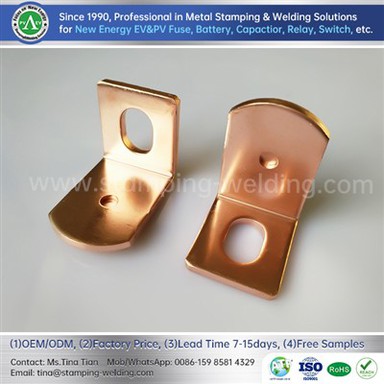
Deep drawing is the core process of stretching brass sheet metal through a mold, which is divided into shallow deep drawing and deep deep deep drawing. The forming depth is determined by the mold cavity. Bending is the process of forming the angle of the Brass contact plug pin for electric switch socket parts, usually arranged after stretching. During the operation, it is necessary to control the corner radius, avoid sharp angles and complex cuts, prevent deformation near the hole position, and ensure the accuracy of the formed dimensions.

Specification and Method for Brass Bending Process
Bending is a key forming step in Brass metal stamping parts electrical accessories components, and reasonable process parameters can effectively avoid cracking, deformation, and burrs. In production, it is generally required that the corner radius is not less than half of the thickness of the board, reducing sharp angles and complex cuts. The width of the gap and protrusion should be about 1.5 times the thickness of the material, and bending near the hole position should be avoided as much as possible.
The common bending methods for Brass precision stamping parts include air bending, embossing, and bottoming. Air bending uses V-shaped molds to adapt to workpieces of different thicknesses, while embossing and bottoming apply greater pressure in a closed cavity, suitable for bending scenarios with higher precision requirements, ensuring stable angles and controllable rebound.
Common Tools and Applications
Electrical contact stamping brass parts custom relies on specialized tools to achieve force forming, and different tools are adapted to different production scales and precision requirements. Bent steel bars are suitable for simple bending operations, forming angles through support and pressure; Strike fixtures are commonly used for manual stamping and can stably apply forming force.
The stamping die for Electrical connector socket brass stamping is the core of large-scale precision production, which is divided into single station and multi station structures. With the help of a punch, it completes composite actions such as material dropping, punching, and forming, and can stably process high-precision contours in batches to meet the continuous production needs of complex structural components.

contact us
If you have any questions about Sheet metal brass stamping material selection, process selection, or tool adaptation, please feel free to contact us at any time. We will provide you with professional technical guidance and customized solutions to help you efficiently advance production projects.