Solving the pain points of rigid connections, Copper Laminated Flexible Busbars lead the transformation of power distribution systems towards flexibility
Jan 30, 2026
As power transmission and distribution systems upgrade towards miniaturization and efficiency, Flexible Copper Busbars, with their unique advantages, are gradually becoming a core solution to overcome the limitations of rigid conductor installation. Among them, the Copper Laminated Flexible Busbars, a family of copper flexible bars, has become a focus of attention in the fields of new energy and power equipment due to its adaptability to complex needs in various scenarios. As a new type of electrical connection device, the copper laminated flexible bar, also known as a flexible copper laminated bar, is made of multiple layers of thin copper foil or copper sheets. It combines excellent flexibility with high conductivity, specifically addressing the mechanical limitations and space challenges faced by rigid conductors in installation and use, providing a new path for power distribution system optimization.

Process Flow
Substrate Selection and Cutting: High-purity copper foil is selected as the core substrate. The thickness is precisely controlled within the 0.05-0.3 mm range according to Copper Flexible BusBar specifications. After precision cutting, impurities are removed and edges are trimmed, laying a solid foundation for subsequent product stacking and ensuring the substrate's conductivity and flexibility meet standards.
Lamination and Welding: The cut copper foil is layered according to design requirements, with precise control over stacking accuracy and flatness. Then, a rigid connection is formed at both ends of the Flexible BusBar using polymer diffusion welding or pressure welding processes, while retaining a flexible structure in the middle, balancing connection strength and usability.
Insulation Treatment and Testing: The formed Flexible Copper BusBar undergo specialized insulation treatment, with a high-temperature resistant insulating film applied to enhance safety. Subsequently, multi-dimensional testing for conductivity, flexibility, and corrosion resistance is conducted, eliminating substandard products and ensuring that the products meet the application standards of various industries.

Structural level
- Substrate Properties Compatibility: The Tinned Copper BusBar uses high-purity flexible thin-film copper sheets as the core substrate, precisely limited to a thickness range of 0.05-0.3 mm. This satisfies the structural adaptability of multi-layer stacking while leveraging the inherent advantages of copper to endow the product with excellent conductivity, balancing structural toughness and electrical transmission efficiency.
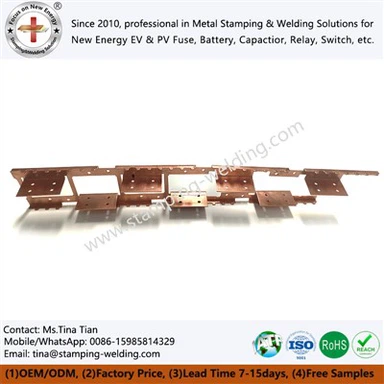
- Layered Structure Design: The Copper BusBars adopts a layered stacking core structure design. By precisely controlling the number and arrangement of copper foil stacks, the bonding accuracy between layers is optimized. This strengthens the overall structural rigidity of the product while reserving ample flexible space in the middle area, adapting to complex installation requirements.
- End Partitioning Process: The Flexible copper laminated busbar adopts a partitioned structure design of "rigid ends + flexible middle." The ends are precision welded to form a stable connection surface, suitable for fixed equipment installation. The middle area retains its flexible characteristics, which can buffer vibration and compensate for installation deviations, balancing connection reliability and usage flexibility.
- Full-dimensional insulation structure: The Automotive Copper Busbar is equipped with an all-round insulation protection structure. By applying a high-temperature resistant insulating film to the surface, the copper foil layers are fully wrapped, which not only eliminates the risk of electrical short circuits, but also does not affect the product's flexible bending performance, ensuring the safety of the product under complex working conditions.

Application scenarios
- In the new energy vehicle: As a key category of Automotive Copper Busbars, the product is well-suited to the space-constrained and vibration-prone conditions of new energy electric vehicles. It flexibly adapts to connections between battery packs and high-power modules such as inverters and motor controllers. Its superior flexibility and stability ensure efficient power transmission in the vehicle's electrical system, meeting the demands of lightweight and modular vehicle development.
- In the power equipment: In high and low voltage switchgear, vacuum equipment, transformers, and other power equipment, the product effectively compensates for installation errors, buffers equipment vibrations, and optimizes connection stability. It is also suitable for generators and busbars, rectifiers, and enclosed busbars, improving power system efficiency with high conductivity and facilitating the miniaturization and upgrading of power distribution equipment.
- In multi-industry applications: Due to its flexible adaptability, the product has achieved large-scale application in transportation, communications, computers, and industrial electric furnaces, among other fields. It can address the spatial layout and power transmission needs of different scenarios, balancing ease of installation and long-term reliability, providing flexible connection solutions for power distribution system upgrades across various industries.

Industry development trends
- Driven by green and low-carbon principles, adapting to the upgrade of new power systems: Under the "dual carbon" goal, the construction of new power systems is accelerating, increasing the demand for clean energy grid connection, and making high-efficiency and energy-saving electrical connection components highly sought after. With its high conductivity and low loss advantages, the Flexible BusBar is suitable for wind power, photovoltaic, and other scenarios, aligning with the green development orientation and continuously expanding its application boundaries to support energy transformation.
- High-end and intelligent upgrades, meeting customized needs for multiple scenarios: The growth of new loads is driving the upgrade of power distribution components towards miniaturization and flexibility, making high-end and intelligent power equipment a trend. Based on multi-layer stacking technology, the Laminated Flexible BusBar can be customized and optimized for structural performance, adapting to complex operating conditions. Combined with digital and intelligent production to improve quality, it meets the high-end power distribution needs of multiple fields.
summary
Copper laminated flexible busbars, with their high-quality base material, scientific structural design, and excellent electrical performance, are manufactured through standardized processes and are suitable for multiple industry scenarios. They combine reliability and flexibility, aligning with the industry development trends of green, low-carbon, and high-end intelligence, making them a high-quality flexible connection solution that empowers the upgrade of power distribution systems.
contact us
In practical engineering applications, the technical principles of the aforementioned Copper Laminated Flexible Busbars ultimately need to be realized through specific product design. Different combinations of structures and materials will directly affect the long-term stability of the system.