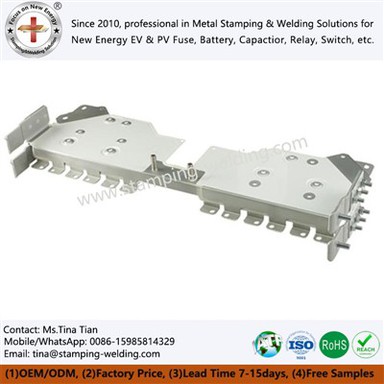
Deepening expertise in electroplating technology to unlock the value of Standard Nickel Plating Flat Busbar
Feb 01, 2026
In the wave of precision power distribution and miniaturization upgrades of industrial equipment, Standard Nickel Plating Flat Busbar, as a core conductor component that combines conductivity reliability and environmental adaptability, is gradually becoming the preferred solution in the fields of electronics, automotive and power distribution, thanks to its diverse technological advantages and standardized manufacturing system.

Materials and Design
- In terms of materials: Nickel Copper Busbars are the mainstream product, using high-purity red copper as the base material. They possess excellent conductivity and mechanical toughness, making them more suitable for mid-to-high-end precision power distribution scenarios compared to aluminum base materials. Flat Bar Red Pure Copper Nickel Plating further improves power transmission efficiency through strict control of base material purity. The nickel layer, as a functional plating, not only fills the gap in corrosion resistance of bare copper conductors but also optimizes the surface contact performance of the conductor, forming a dual advantage of "base conductivity + plating protection."
- In terms of design: The flat structure balances space utilization and heat dissipation efficiency. Compared to round busbars, it is more suitable for the installation layout of dense power distribution equipment. Furthermore, standardized size control ensures precise compatibility with power distribution components such as circuit breakers, terminals, and connectors, reducing assembly errors and highlighting the practicality and compatibility of the design.

Technical features and production process
- Substrate Pretreatment, Laying a Solid Foundation for Production: At the initial stage of production, the Nickel-Plated BusBar substrate undergoes meticulous pretreatment. Through a complete process including degreasing, rust removal, and polishing, surface impurities and oxide layers are removed, ensuring the substrate surface's smoothness and cleanliness. This lays a solid foundation for the stability and adhesion of the subsequent nickel plating process.
- Precision Nickel Plating Control, Enhancing Protective Performance: Controlled electroplating technology is used for precision nickel plating, accurately controlling the plating thickness and uniformity to ensure complete nickel coverage of the substrate surface. This avoids quality issues such as plating peeling and pinholes, simultaneously enhancing the Nickel Plated Copper Busbars's corrosion resistance and surface abrasion resistance.
- CNC Forming and Calibration, Meeting Standard Specifications: CNC machining technology completes product forming and dimensional calibration, precisely controlling key parameters such as busbar width and thickness. Strict adherence to standardized production specifications ensures product compatibility with various power distribution components and reduces assembly errors.
- Composite technology integration for optimal conductivity: The Nickel Plated BusBars integrates electroplating protection and conductor conductivity optimization technologies. The nickel layer forms a dense protective structure to resist corrosion under complex working conditions, while the low impedance characteristics of the substrate ensure efficient current transmission, achieving a dual improvement in product protection and conductivity.
- End-to-end quality control for consistent batches: Strict quality control is implemented throughout the entire production process, adhering to international electroplating standards. Each batch of Nickel plated Copper BusBar undergoes batch-by-batch testing for nickel plating quality, dimensional accuracy, and conductivity, eliminating defective products to ensure consistent product performance and delivery quality.

Scenario empowerment
In the electronics and precision machinery sector: The Standard Nickel Plating Flat Busbar is compatible with miniaturized, high-density power distribution links. With its excellent conductivity and protective performance, it aligns with the trend of equipment miniaturization and upgrades, providing reliable support for stable power distribution in precision equipment, highlighting the product's refined adaptability advantages.
In the automotive industry: The Nickel Plated Copper Flat BusBar effectively resists the corrosive effects of the complex automotive environment, withstands mechanical stress and environmental corrosion, ensuring the long-term stable operation of the vehicle's power distribution system. It meets the stringent requirements of vehicle power distribution, demonstrating the product's durability and environmental adaptability.
In the power distribution system sector: With its standardized dimensions and good compatibility, the Flat BusBar Red Pure Copper Nickel Plating simplifies wiring layout, improves the stability and ease of maintenance of power distribution links, efficiently completes power distribution, and helps power distribution systems upgrade towards higher efficiency and standardization.

Summary
With the continuous improvement of industrial electrification, the demand for high-performance conductors is constantly increasing. As a solution that combines functionality and economy, the standardization and modular application trend of Nickel plated copper busbars will be further strengthened. In the future, the industry is expected to achieve new breakthroughs in coating process optimization and material composite innovation, promoting the widespread application of Nickel plated bus bars in more demanding operating conditions.
contact us
In practical engineering applications, the technical principles of the Standard Nickel Plating Flat Busbar ultimately need to be realized through specific product design. Different combinations of structures and materials will directly affect the long-term stability of the system.