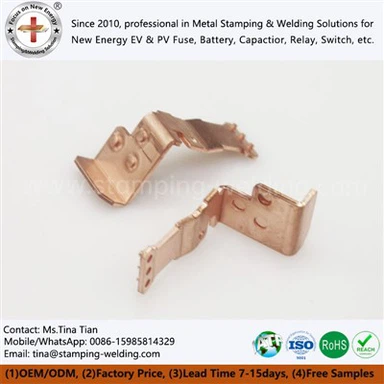
Differences Between Precision Copper Stamping Parts And Brass Sheet Metal Stamping Parts
Jan 14, 2025
Brass and copper, as common metal materials, are widely used in the field of stamping parts production. However, there are significant differences between the two materials in terms of appearance, composition, physical properties, processing performance, and uses. This article will introduce in detail the differences between brass and copper in stamping parts production to help readers better understand these two materials and choose appropriate raw materials according to actual needs.

1. Appearance characteristics
The two materials present completely different colors in appearance. Brass Sheet Metal Stamping Parts is light golden yellow in color and has a lustrous surface. This unique yellow color comes from the addition of zinc in the alloy. Precision Copper Stamping Parts is known for its unique rose red color and also has a bright luster. Through intuitive color comparison, we can preliminarily distinguish brass from copper.
2. Composition
Brass is mainly composed of two elements, copper and zinc, of which the copper content is about 60% and the zinc content is about 40%. Some special brasses may also contain other elements such as lead, tin, manganese, nickel, etc. The addition of these elements makes the performance of brass more diverse. In contrast, red copper, the common name for pure copper, has a copper content of over 99.9% and contains almost no other impurity elements. Therefore, it has extremely high purity and excellent electrical and thermal conductivity.
3. Physical properties
There are also significant differences between brass and copper in terms of their physical properties. The density of Brass Sheet Metal Stamping Parts is relatively high, about 8.93g/cm³, which is closely related to its alloy composition. The density of copper is slightly lower, about 7.83g/cm³. In addition, due to the different composition, the hardness, strength and other mechanical properties of brass are also better than those of copper, which makes brass perform well in wear resistance and corrosion resistance. However, Precision Copper Stamping Parts occupies a pivotal position in the electrical industry due to its excellent electrical and thermal conductivity.

4. Processing performance
In the production of stamping parts, the processing properties of brass and copper are different. Brass Custom Stamping Parts, due to the characteristics of its alloy composition, has relatively good cutting performance and is easy to process into various shapes and sizes. In addition, the material has high hardness and is not easy to deform, so it can maintain good shape stability during the stamping process. However, due to its high purity and good toughness, Red Copper Stamping Parts are prone to burrs and deformation during cutting, and are relatively difficult to process. However, the material has high plasticity and is easier to deform, such as bending and stamping, making it suitable for manufacturing stamping parts that require a lot of deformation.
5. Differences in usage
The difference in the uses of these two materials is also very obvious. Brass Stamping Small Parts is widely used in manufacturing various stamping parts with complex shapes, such as hardware, water tank belts, water supply and drainage pipes, medals, etc. due to its good processing performance and corrosion resistance. Especially in the fields of construction, machinery, shipbuilding, etc., brass is one of the indispensable materials. Copper Pressed Components have become the "protagonist" in the electrical industry due to their excellent electrical and thermal conductivity. They are widely used in the manufacture of wires, cables, brushes and other products that require good conductivity. In addition, the material has good ductility and toughness and can be used to make parts for various precision instruments and meters.
6. Cost Considerations
In stamping parts production, cost is also an important factor to consider. Brass Stamping Small Parts has a relatively high production cost because it contains a variety of alloy elements. However, the good properties and wide application fields of brass make it have a high market value. In contrast, although Red Copper Stamping Parts has high purity and good performance, its production cost is relatively low, so it has a higher cost-effectiveness in some fields with high requirements for electrical conductivity and thermal conductivity.

In summary, brass and copper each have their own advantages and disadvantages in the production of stamping parts. Copper Pressed Stamped Parts are favored for their good processing performance, corrosion resistance and wide range of applications; Brass Precision Stamping Parts are favored for their excellent electrical and thermal conductivity and high plasticity in the electrical industry and parts that require a lot of deformation. plays an important role in the manufacturing process. When selecting raw materials, comprehensive consideration should be given based on specific needs and process characteristics.
If you want to know more about our products or services, please click on the business card below to contact us!