
EV Fast Fuse: The Key Defense Line Safeguarding The Safety Of Green Energy
Apr 24, 2025
With the vigorous development of the global new energy industry, electric vehicles, photovoltaic power plants, wind farms, and various energy storage facilities have witnessed explosive growth. In this wave of energy transformation, EV Fast fuse, with its outstanding performance, has become a core component ensuring the safe and stable operation of new energy systems and is attracting the attention of the entire industry.
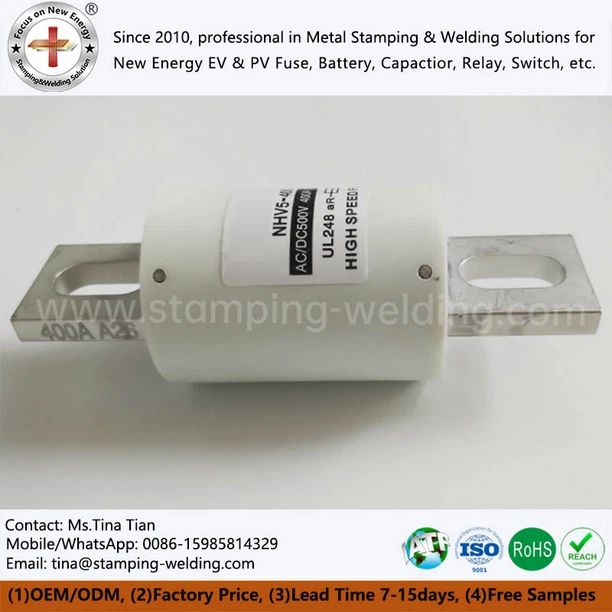
Definition and Function of New Energy Fast Fuses
As a specialized overcurrent protection device, the new energy fast fuse, also known as High Speed Fuse or Fast Acting Fuse, can cut off the circuit at an extremely fast speed the moment an abnormal overcurrent or short-circuit fault occurs in the circuit, thus preventing other electrical equipment from being damaged by large current surges. In the charging process of electric vehicles, once a short circuit occurs in the circuit between the charging pile and the vehicle, the Fast Acting Fuse can respond within just a few milliseconds and quickly cut off the current, protecting core components such as the charging module, battery management system, and vehicle battery. In the energy storage system, the Energy storage overload protection fuse plays the role of a "safety guard". When the battery pack experiences abnormalities such as overcharging and over-discharging leading to out-of-control current, it can promptly cut off the circuit, effectively preventing serious accidents such as battery thermal runaway, fire, and even explosion, ensuring the safe and reliable operation of the energy storage system.
Working Principle of New Energy Fast Fuses
From a technical perspective, the working principle of the EV fast fuse is based on the thermal effect of electric current. Its internal melt is usually made of high-purity metal materials such as silver and copper, which have good electrical conductivity and relatively low melting points. When the circuit is operating normally, the current passing through the melt is within the rated range, generating very little heat, and the melt remains in a solid state, ensuring the smooth flow of the circuit. However, when an overcurrent occurs in the circuit, according to Joule's law, the increase in current causes the heat generated by the melt to rise sharply. Due to the low melting point of the melt material, the heat will raise its temperature to the melting point in a short time, causing the melt to blow and quickly cut off the circuit. Compared with ordinary fuses, the melt of the new energy fast fuse often adopts a special structural design, such as a variable cross-section structure with deep V-shaped grooves. This design allows the melt to blow faster under overload conditions, meeting the strict requirements of new energy systems for rapid protection.

Wide Application of New Energy Fast Fuses
In the application market, the EV fast fuse can be found in various fields of the new energy industry. In the electric vehicle industry, whether it is a DC fast charging pile or an AC slow charging pile, it cannot function without its protection. In renewable energy power generation systems such as photovoltaic and wind power, the High Speed Fuse plays a key role in the circuit protection of photovoltaic panel arrays and the protection of internal equipment of wind turbines. With the continuous expansion of the new energy market scale, the market demand for fast fuses is also showing a strong growth trend.

Development Trends of the New Energy Fast Fuse Industry
It is worth noting that the current new energy fast fuse industry is developing rapidly in multiple directions. On the one hand, as new energy technologies move towards higher voltages and greater powers, higher requirements are put forward for the voltage and current ratings of fast fuses, and the industry is actively researching and developing to improve the rated parameters of products to adapt to this trend. On the other hand, intelligence has become a new development hotspot. Future fast fuses are expected to be integrated with sensors to achieve real-time monitoring of their own status and circuit operation parameters, and transmit the data to the monitoring center through the Internet of Things technology for remote diagnosis and fault early warning, greatly improving the operation and maintenance efficiency and reliability of new energy systems. In addition, in terms of miniaturization, integration, and environmentally sustainable development, the EV fast fuse is also constantly exploring and innovating to better meet the development needs of the new energy industry.
In the context of the global acceleration of the transition to clean energy, the new energy fast fuse, as a key link in ensuring the safe operation of new energy systems, has become increasingly important. With the continuous progress of technology and the continuous growth of market demand, more breakthroughs are expected in this field, laying a solid safety foundation for the high-quality development of the new energy industry.
contact us