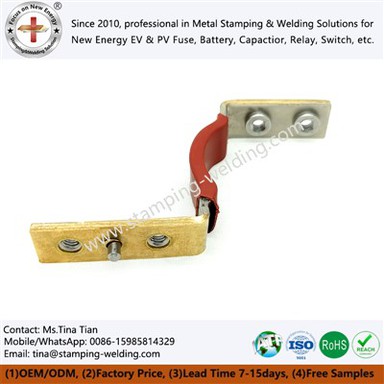
Core knowledge and application specifications of PE Heat Shrink Tube Insulated Busbar
Jan 14, 2026
Heat shrinkable materials are blended polymers composed of rubber and plastic, which are transformed into a network structure through irradiation or chemical methods. They have a unique "memory effect" - they are rapidly cooled and shaped after being heated and expanded, and then heated to a specific temperature before use to shrink to their original size. As a pipe made of this material, the core purpose of the PE Heat Shrink Tube Insulated Busbar is to be installed on the busbar of electrical equipment. After heating and shrinking, it can achieve safety protection or shorten the insulation distance between phases. It is usually made of high-quality PE material and has the characteristics of uniform wall thickness and compliance with ROHS standards. It also has important insulation adaptation value in EV Battery Connector related electrical systems.

Guidelines for operating casing and using heating tools
The operation of the casing and the use of heating tools must strictly follow the specifications: when using the casing, the cut of the heat shrink tube should be kept neat and smooth, and burrs or cracks should be avoided to prevent the spread of cracks due to stress concentration during heating shrinkage; The selection of heating tools is relatively flexible, including constant temperature ovens, propane lamps, liquefied gas open flames, gasoline spray lamps, and industrial electric hot air guns. If a hair dryer or liquefied gas spray gun is used, it should be uniformly heated from one end to the other, or gradually heated from the middle to both ends. It is strictly prohibited to heat from both ends to the middle, otherwise it may cause air bulging and affect the PE Heat Shrink Tube Insulated Busbar effect. For heating tools with high temperatures, such as spray guns with temperatures ranging from 400 ℃ to 600 ℃ and tools that generate blue flames above 800 ℃, it is necessary to strictly control the distance between the flame and the main heat shrink tube during use, maintain a distance of 4-5cm, and move evenly. The flame should form a 45 ° angle with the surface of the heat shrink tube, and heat should be moved while moving throughout the entire process. It is not allowed to approach the surface of the sleeve too closely or concentrate heating in a certain area to avoid uneven thickness or burns of the sleeve, ensuring the integrity of the Busbar Insulating Tubing.

Busbar Insulation Sheet processing flow
The treatment after heating is equally crucial and directly affects the stability of insulation protection. The processed busbar should be placed flat on a clean and soft platform to prevent surface scratches, and should be repaired after complete cooling. At the same time, it is important to focus on organizing the Busbar Sleeves Insulation at the corners of the busbar to avoid wrinkles and ensure overall insulation and sealing. If using an oven for heating, the retraction temperature should be controlled between 100 ℃ and 130 ℃. The heating time for conventional specification busbars is 5-10 minutes, while for larger specification busbars, it needs to be extended to 20-30 minutes. After baking, it is necessary to let it stand for 3-5 minutes before taking it out for cooling. Then, cut the Busbar Insulating Tubing at a distance of 10mm from the edge of the overlapping surface, and keep the cutting edge neat.

Acceptance criteria and material selection after heat shrinkage
The final acceptance of the Customized Busbar Insulating Tube must meet clear standards: the surface must be clean and flat, with uniform shrinkage, no burning, fading, bubbles, or cracking, no wrinkles at bends, and no scratches on the surface, which is essentially consistent with the insulation protection requirements of the Solid Insulation Tubing Busbar. It is worth noting that in different application scenarios, suitable insulation materials can be selected according to actual needs, such as PE Heat Shrink Tube Insulated Busbar, Heat Shrink Tubing BusBar, or Heat Shrink Sleeves BusBar, to ensure the insulation safety and stability of the electrical system.
contact Us