What are the differences between the four types of busbar insulation processes? A selection guide for dip coating, powder coating, heat-shrink tubing, and injection molding insulation
Aug 08, 2026
As core conductive components in new energy vehicles, battery energy storage systems, PCS cabinets, and industrial power distribution equipment, Insulated Copper BusBar are primarily responsible for power transmission under conditions of high current and high voltage. As new energy equipment evolves toward higher voltages and power densities, factors such as safety clearance between busbars, insulation reliability, and space utilization have become critical considerations in engineering design.
Insulation treatment effectively mitigates the risks of short circuits, arcing, and creepage between busbars while enhancing operational stability in demanding environments characterized by vibration, humidity, and high temperatures. Common industry methods for busbar insulation include dip coating, powder coating, heat-shrink tubing, and plastic injection-molded housings. These processes differ significantly in terms of materials, manufacturing techniques, structural adaptability, and cost; therefore, the appropriate method must be selected based on the specific application scenario.

Key Differences Among Four Busbar Insulation Processes
The four insulation technologies differ in their protective principles, structural properties, and application scenarios; key distinctions lie in insulation thickness, voltage withstand capability, structural compatibility, and cost, allowing them to meet the insulation needs of various operating conditions.
PVC dipping involves fully encapsulating the busbar in PVC material. This method provides substantial insulation thickness and exceptional resistance to mechanical impact and abrasion. It accommodates various irregular or complex busbar shapes and is widely used for battery connection bars. While PVC-dipped bars offer robust protection and shape versatility, their primary drawback is the significant insulation thickness, which imposes strict requirements on installation space precision and product dimensional control.
Heat-shrink tubing offers a simple, convenient, and low-cost insulation process. The tubing shrinks under high heat to tightly encase the busbar, making it suitable for standard flat or rectangular bar configurations-ideal for battery modules and small-batch R&D prototypes. Although heat-shrink insulation allows for short processing cycles and high flexibility, it is less compatible with complex, irregular busbar shapes and cannot meet insulation requirements for specialized structural designs.
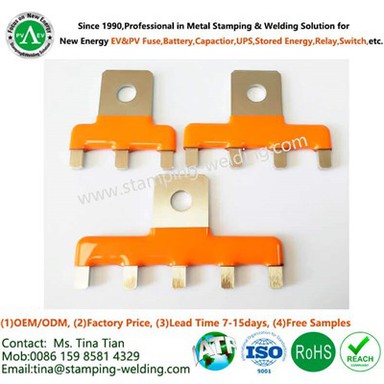
Powder coating (specifically epoxy powder coating) utilizes an electrostatic spraying process to apply a uniform layer of epoxy powder onto the busbar surface. The resulting coating is smooth and even, offering excellent voltage withstand capabilities and superior high-voltage insulation performance. This method maximizes equipment space utilization, making it suitable for high-voltage applications. Epoxy powder-coated busbars are frequently used in PCS cabinets, large-scale energy storage systems, and high-voltage power distribution equipment; they serve as a preferred insulation solution for high-voltage power transmission, ensuring the safe and stable operation of power distribution systems.
Injection molding involves encapsulating the busbar directly within plastic material through an integrated molding process. This results in superior structural integrity, high mechanical strength, and excellent resistance to vibration and aging, making it ideal for highly integrated electrical components. Characterized by high strength and stability, injection-molded busbars (such as PA66 plastic-insulated versions) are commonly used in high-voltage power distribution boxes for new energy vehicles and modular power components. Their main disadvantage is the high initial cost of mold development, rendering them unsuitable for small-batch production.

What capabilities should be considered when selecting a busbar insulation supplier?
For procurement in the new energy and power equipment sectors, suppliers must not only provide Insulated Copper BusBar products but also possess comprehensive manufacturing and quality control capabilities.
Key considerations include:
- Copper busbar processing capabilities
Includes processes such as stamping, bending, CNC machining, and welding to ensure dimensional stability of the busbar structure.
- Custom development support
Ability to design custom powder-coated busbars or specially structured insulated busbars based on the client's electrical parameters and installation requirements.
- Insulation testing capabilities
Includes withstand voltage testing, insulation resistance testing, coating thickness measurement, and visual inspection.
- Mass production and delivery capabilities
Stable production processes and quality management systems help mitigate supply risks.
- Compliance with industry quality system standards
The new energy and automotive industries typically prioritize certifications such as ISO9001 and IATF16949.
Selecting the appropriate busbar insulation process affects not only manufacturing costs but also-more critically-the operational safety and long-term reliability of the equipment. By evaluating factors such as the application environment, electrical requirements, and production scale, one can select the insulation solution best suited to the project's needs.

Contact Us
If you are developing Insulated Copper BusBar products for new energy vehicles, energy storage systems, or high-voltage power distribution equipment, we can provide recommendations on process selection, support for structural optimization, and customized manufacturing solutions tailored to your application needs, helping to enhance product reliability and production efficiency.