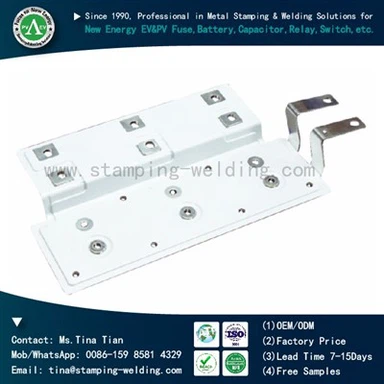
How to Select Copper Busbar with Epoxy Powder Coatings for High-Voltage Applications? Insulation Properties and Selection Guide
Aug 05, 2026
With the development of new energy vehicles, energy storage systems and high-voltage power equipment, bars, as an important connection component for large current transmission, have continuously increased requirements for insulation performance, space utilization and long-term reliability. In 800V new energy vehicle platforms, energy storage PCS cabinets, photovoltaic inverters and industrial power distribution equipment, traditional bare copper bars are no longer able to meet high-voltage safety requirements, so it is necessary to improve electrical isolation capabilities through insulation processes. Among them, Copper Busbar with Epoxy Powder Coating form a uniform epoxy resin insulation layer on the surface of the copper bar, which maintains good conductivity while improving voltage resistance, moisture resistance and environmental aging resistance, becoming a common solution in high-voltage busbar applications.

Why do high-voltage systems require copper busbars coated with epoxy powder?
During the operation of high-voltage systems, busbars must not only carry high continuous currents but also withstand higher voltage levels, accommodate compact installation spaces, and meet stringent safety clearance requirements. Applications such as high-voltage power distribution systems in new energy vehicles, energy storage battery cluster interconnects, and PCS power modules require minimized risks of inter-conductor short circuits alongside optimized internal cabinet layouts.
Utilizing epoxy powder-coated copper busbars allows the coating to replace a portion of the clearance traditionally provided by air insulation, thereby enabling a more compact bar design. The resulting insulating layer mitigates the risk of tracking caused by dust, moisture, or vibration, while enhancing the operational stability of the busbars in demanding environments.
What key parameters should be considered when selecting epoxy powder-coated busbars?
During actual procurement, one should not focus solely on insulation thickness; instead, a comprehensive assessment considering system voltage, current, installation method, and environmental conditions is required.
1. Insulation Class and Withstand Voltage Performance
For high-voltage applications, the first step is to verify that the insulation coating meets the system's withstand voltage requirements. Key factors include:
- Epoxy coating thickness;
- Dielectric breakdown strength;
- Surface insulation distance;
- Long-term thermal stability.
Coating parameters for epoxy-coated insulated copper busbars must be designed according to specific voltage levels-such as 800V systems for new energy vehicles or 1500V systems for energy storage-to ensure the insulation class matches the application and to prevent partial discharge or insulation failure caused by inadequate coating.
2. Current-Carrying Capacity and Heat Dissipation Design
The primary function of a busbar remains electrical power transmission; therefore, selection criteria must include copper specifications, cross-sectional area, and operating temperature rise.
While the epoxy powder coating provides insulation, it must not compromise the busbar's heat dissipation performance. An effective epoxy powder coating solution for power distribution bars strikes a balance between insulation thickness and thermal management, enabling the busbar to handle both continuous and transient current requirements.
3. Structural Complexity and Installation Compatibility
Internal space varies significantly across different types of equipment, often necessitating structural features such as bends, holes, and multi-point connections. For complex geometries, powder coating insulation can effectively cover irregular shapes while maintaining continuous insulation coverage.
Compared to traditional sleeving methods, custom epoxy powder-coated copper busbars are better suited for space-constrained, multi-bend, and high-density installation environments; they eliminate the need for additional insulation accessories and improve overall assembly efficiency.

How does the epoxy powder coating manufacturing process for busbars affect product performance?
The reliability of epoxy powder-coated busbars depends not only on material selection but also on production process control. The complete manufacturing workflow typically encompasses busbar fabrication, surface treatment, powder coating, and curing/inspection.
First, the busbars are fabricated according to product design specifications-utilizing processes such as laser cutting, stamping, CNC machining, and precision bending-to ensure dimensional accuracy for assembly.
Next, surface pretreatment is performed; steps such as cleaning, degreasing, and oxide layer removal are employed to enhance surface reactivity and improve coating adhesion.
During the coating stage, electrostatic powder spraying is used to ensure the uniform deposition of epoxy powder onto the busbar surface, followed by high-temperature curing to form a stable insulating layer. The powder coating process requires strict control over coating uniformity, curing temperature, and coating thickness; failure to do so may result in defects such as pinholes, peeling, or localized insulation failure.

How do you select powder-coated busbars for different application scenarios?
Different equipment has varying requirements for busbar performance; therefore, selection during procurement must take the actual operating environment into account.
| Application Scenarios | Key Considerations for Model Selection |
| Energy Storage PCS System | High voltage withstand, low inductance, and stable long-term operation. |
| New Energy Vehicle High-Voltage System | Space utilization, vibration resistance, and reliable insulation |
| PV inverter | Environmental tolerance and continuous operational stability |
| Industrial power distribution equipment | Mechanical strength, moisture resistance, and contamination resistance |
For instance, energy storage equipment typically employs Copper Busbar with Epoxy Powder Coating to meet high-voltage isolation requirements, whereas the powertrains of new energy vehicles place greater emphasis on structural compactness and insulation reliability under long-term vibration conditions.
What should be considered when sourcing suppliers for epoxy powder-coated busbars?
When selecting suppliers, engineering procurement professionals must look beyond product pricing and evaluate comprehensive manufacturing capabilities.
Key considerations include:
- Capabilities for copper busbar fabrication and insulation processing;
- Support for irregularly shaped busbars and the development of custom structural designs;
- Quality control capabilities, such as withstand voltage testing and dimensional inspection;
- Capacity for stable, mass-volume delivery;
- Compliance with quality management standards such as ISO9001 and IATF16949.
High-voltage equipment operates in demanding environments; therefore, busbar products require a comprehensive quality control system covering design, fabrication, insulation, and inspection. Custom insulated copper bars for high-voltage equipment must be engineered based on specific voltage ratings, current parameters, and installation space constraints to ensure long-term operational reliability.
Contact Us
Different application scenarios entail varying requirements for busbar dimensions, insulation ratings, and structural designs. Our engineering team can provide Copper Busbar with Epoxy Powder Coating solutions tailored to your electrical specifications and installation needs, and is available to support project evaluation and technical consultations.