How to Solve Terminal Overheating Problems in Braided Flexible Copper BusBar?
Jul 25, 2026
In high- and low-voltage electrical systems and power distribution systems for new energy equipment, Braided Flexible Copper BusBar serve as critical conductive connectors; however, overheating at the busbar terminals is a frequent equipment fault. Although seemingly minor, this issue leads to accelerated insulation aging and equipment damage due to overloading, and in severe cases, excessive terminal temperature rise may accelerate insulation aging, reduce connection reliability, and cause unexpected equipment downtime. Directly compromising the operational stability and safety of the entire electrical system, this phenomenon represents a critical risk factor that demands close attention in both equipment design and electrical operations and maintenance.

Main Causes of Flexible Busbar Terminal Heating
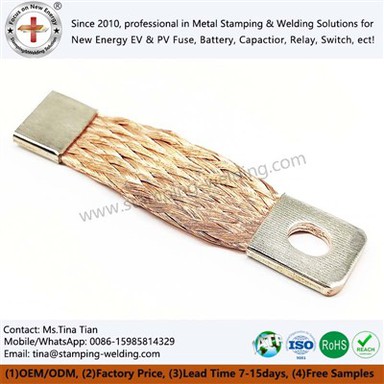
Overheating at the terminals of flexible copper braided connectors is primarily caused by abnormal local resistance, uneven current distribution, and poor heat dissipation. The root causes fall into four categories: abnormal contact resistance, improper specification selection, manufacturing defects, and installation environment issues. Abnormal contact resistance is the most common cause; during long-term operation, terminals are prone to oxidation, dirt accumulation, or loose fitting, leading to a sharp rise in contact resistance. This causes heat to accumulate when energized, resulting in terminal overheating.
Improper specification selection often stems from errors in initial design load calculations. If the conductive cross-section of the selected connector is insufficient, issues such as inadequate current-carrying capacity and excessive current density arise. This leads to uneven current distribution and localized overloading within the braid, causing sustained heating.
Manufacturing defects in the terminals are a particularly insidious root cause. Issues such as loose crimping, broken copper strands, uneven tin plating, or uneven contact surfaces reduce the effective conductive cross-section and create resistance imbalances. Even with proper installation and operating conditions, connectors with substandard manufacturing quality will experience localized heat concentration during operation, leading to recurring failures.
Installation environment and operating conditions are critical external factors. Equipment vibration and thermal expansion/contraction can loosen bolts, thereby increasing contact resistance. Furthermore, poor heat dissipation in confined spaces hinders thermal release; when combined with eddy current losses, heat accumulates continuously, ultimately resulting in a persistent high-temperature fault at the terminal.
Solutions for Systematic Screening and Remediation
To address the aforementioned overheating issues, the industry follows a troubleshooting protocol that prioritizes the easiest fixes first and addresses external factors before internal ones, enabling rapid fault localization and remediation. Priority should be given to optimizing installation and connection procedures: standard torque wrenches must be used to tighten bolts on flexible tinned copper braided connectors to prevent loosening, and fasteners showing plastic deformation must be promptly replaced. Additionally, contact surfaces at the terminals should be cleaned-removing oxidation and burrs-and coated with conductive paste to minimize contact resistance.
Next, product selection and installation conditions should be optimized. Current carrying capacity should be evaluated based on conductor cross-section, allowable temperature rise, installation environment, and cooling conditions, and any copper braided flexible connectors with insufficient cross-sectional areas or inadequate current-carrying capacity must be replaced. During installation, connectors should maintain a natural, slight curve to avoid tensile stress; routing should be adjusted to mitigate eddy current effects, and surrounding obstructions cleared to ensure adequate ventilation and heat dissipation.
Finally, equipment structure and operational hazards should be rectified. To address issues such as busbar deformation or uneven contact surfaces, use appropriate anti-loosening structures to maintain stable contact pressure under vibration and thermal cycling conditions. If overheating faults persist with crimping methods, the terminal connection process can be upgraded to brazing or tin dipping; this creates an integrated bond between the connector terminal and the copper busbar, thereby fundamentally reducing the likelihood of overheating.

Product Quality Control Standards
To minimize overheating issues in Braided Flexible Copper BusBar, quality control at the source is paramount. Reputable manufacturers strictly adhere to authoritative quality standards-such as ISO9001-2015, IATF16949, RoHS, and REACH-conducting comprehensive testing on raw materials, manufacturing processes, and finished product performance. By rigorously controlling parameters like braiding density, welding precision, and plating quality, they ensure stable current-carrying capacity and superior oxidation resistance, thereby preventing quality defects such as abnormal resistance or poor fitment right from the production stage.
Our Advantages
Our manufacturing capabilities encompass the forming of braided copper straps, terminal welding, surface plating, and electrical performance testing. Through optimized welding processes and rigorous electrical resistance testing, we assist customers in developing flexible busbar solutions that offer stable current-carrying performance and low temperature rise.
Contact Us
If you are looking for a Braided Flexible Copper BusBar supplier with stable current-carrying performance and customized terminal solutions, we provide support from structure design, welding process optimization to mass production.