How Do Stamped Parts Balance Cost, Electrical Conductivity, And Structural Strength? A Guide To Selecting Materials For Metal Stamping
Aug 15, 2026
Selecting materials for Metal Stamping requires balancing cost, electrical conductivity, structural strength, and manufacturability. No single material can simultaneously offer the lowest cost, highest conductivity, and greatest strength. Procurement teams should first clarify product functionality, then determine the material and stamping process based on the operating environment, sheet thickness, structural design, and procurement volume.

How do you determine the priority for material selection?
For electrical copper stamping parts where electrical conductivity is the primary function, priority should be given to conductivity and contact stability; for parts requiring a balance of electrical and mechanical properties, copper alloys and brass are suitable options; for structural components such as brackets and fasteners, carbon steel or stainless steel should be prioritized.
Key Selection Criteria: Choose copper for conductivity; choose brass for a balance of conductivity and strength; choose carbon steel for a balance of strength and cost; and choose stainless steel for corrosion resistance.
How do different metal materials balance performance and cost?
Copper stamped parts are suitable for products requiring high electrical conductivity, such as terminals, connecting tabs, and conductive strips; brass is ideal for components that require a balance of conductivity, strength, and cost; carbon steel typically offers advantages in terms of strength and cost-effectiveness; while stainless steel is better suited for applications demanding superior corrosion resistance and structural performance.
Therefore, when sourcing, one should not simply compare the unit price of materials but should instead evaluate the total material cost, processing costs, tooling costs, surface treatment expenses, and long-term usage costs.
Request Custom Stamping Cost Evaluation
How can the overall cost of stamped parts be reduced?
Projects such as copper stamping can be optimized in four key areas:
- Material thickness: Avoid over-specification while still meeting strength and conductivity requirements.
- Material utilization: Minimize scrap through efficient layout and nesting.
- Product design: Reduce unnecessary holes, complex bends, and secondary processing.
- Production volume: For stable, high-volume products, evaluate the use of progressive dies to lower long-term unit costs.
Therefore, the lowest material price does not equate to the lowest total procurement cost.

How does structural design influence material selection?
For copper stamped components, factors such as hole placement, material thickness, bend radii, and forming geometry all influence material usage and manufacturing complexity. If strength requirements can be met through bending or localized reinforcement, simply increasing the material thickness is not necessarily required.
For products requiring punching, bending, and joining, an optimized combination of these processes can reduce the need for downstream operations and enhance mass production efficiency.
When should copper be selected for electrical components, and when should brass be chosen?
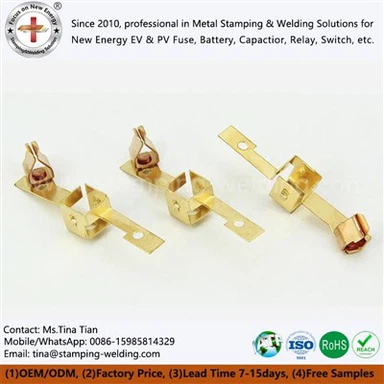
For electrical terminals, contacts, and switch components, brass sheet metal stamping is typically suitable for products requiring a balance of electrical conductivity and mechanical strength; however, if the primary requirements are high conductivity and low electrical resistance, copper should be prioritized.
For instance, when manufacturing brass components for electrical switches and sockets, factors such as conductivity, assembly dimensions, strength, and cost must all be considered; therefore, decisions should not be based solely on material price.
What information needs to be provided for a procurement RFQ?
When sourcing custom metal stamped parts, it is recommended to provide the following information:
- Material grade and thickness
- Product drawing
- Dimensional tolerances
- Electrical or load requirements
- Surface treatment
- Annual volume
This information helps suppliers determine the appropriate materials, tooling, and stamping processes, and allows for a more accurate assessment of production costs.
For high-precision products, key dimensions and functional requirements should be clearly specified; for high-volume projects, the cost-effectiveness of progressive die stamping can also be evaluated.
FAQ
Q: What is the most cost-effective material for Metal Stamping?
A: It depends on the product function. Structural components typically consider steel, while conductive components require comparison between copper and brass.
Q: Which metal is best for electrical stamping parts?
A: Copper is preferred for conductivity; brass can be considered when strength and cost need to be balanced.
Q: How can I reduce metal stamped costs?
A: Optimize material thickness, layout, product structure, mold design, and production volume.
Q: How do I choose the right stamping material?
A: Make a comprehensive judgment based on conductivity, strength, corrosion resistance, cost, and the operating environment.

Contact Us
If you are evaluating stamping solutions for copper, brass, carbon steel, or stainless steel, please provide product drawings, material specifications, operating conditions, and projected purchase volumes so that suitable materials and stamping processes can be assessed.