

How To Select Braided Flexible Busbars: A Selection Guide For Flexible Connections in New Energy Vehicles And Energy Storage Systems
Aug 11, 2026
As new energy vehicles, battery packs, energy storage systems, and high-voltage power distribution equipment evolve toward higher power ratings and greater integration, electrical connection components must simultaneously meet requirements for high-current transmission, mechanical cushioning, and long-term stable operation. Braided Flexible Busbar serve as flexible conductive connectors designed primarily to mitigate mechanical stresses caused by vibration, assembly tolerances, and thermal expansion or contraction. Specifically, flexible copper braided wire connectors with welded ends utilize a multi-strand braided structure combined with welded terminals; this design ensures excellent electrical conductivity while enhancing flexibility and fatigue resistance at the connection points.
In practical engineering applications, the selection of braided flexible bars cannot be based solely on current ratings; a comprehensive evaluation is required, taking into account installation space, operating environments, mechanical loads, terminal configurations, and surface treatment specifications. Proper selection helps minimize contact resistance and control operating temperature rise, thereby enhancing the long-term operational reliability of new energy vehicles, battery systems, and industrial equipment.

Determine the specifications of the flexible busbar based on application conditions
Selecting the right Copper Braided Busbar for Power Distribution begins with a clear understanding of the application environment, including the equipment's operating current, installation location, and mechanical movement characteristics. Different scenarios impose distinct structural requirements; for instance, power battery systems in new energy vehicles must withstand continuous vibration and frequent thermal cycling, whereas internal connections in energy storage cabinets prioritize temperature rise control during prolonged high-current operation.
Current parameters are a critical factor in determining busbar specifications. Design considerations must include rated operating current, peak current, continuous operation duration, and permissible temperature rise. While a larger copper conductor cross-sectional area generally offers higher current-carrying capacity, it also impacts flexibility and installation space requirements. Therefore, selecting a Flat Copper Braid Flexible busbar connector requires matching the product to actual load and heat dissipation conditions, rather than simply choosing a model based on current ratings alone.
In addition to current requirements, the internal space of the equipment is a key design factor. Engineers must consider connection distance, installation orientation, terminal positioning, and bending configurations. Compared to traditional rigid copper busbars, flexible busbars offer superior spatial adaptability; they can accommodate assembly tolerances and reduce mechanical stress at connection points. For space-constrained applications-such as battery packs and high-voltage distribution boxes-flexible copper braided busbars can be customized in terms of length, cross-section, and terminal design to meet specific installation needs.

Select the conductor structure based on current and temperature rise requirements
The core function of braided flexible copper busbars is to facilitate stable, high-current transmission; consequently, the structure of the copper conductor directly impacts product performance. Key factors influencing current-carrying capacity include the copper cross-sectional area, the number of copper strands, the thickness and density of the braid, and the operating ambient temperature.
For low-current applications, a single-layer copper braid structure typically suffices; however, medium- to high-current applications-such as those found in new energy vehicles and battery energy storage systems-require multi-layer braid structures to increase the conductive surface area and reduce current density. When equipment demands even higher current-carrying capacity, reinforced braid structures or laminated designs can be employed to enhance heat dissipation and long-term stability.
For instance, laminated high-current copper wire braided flexible connectors utilize increased conductor layers and optimized structural designs to improve connectivity in high-current environments while maintaining flexibility, making them suitable for power batteries, energy storage systems, and high-power electrical equipment.
It is important to note that actual current-carrying capacity depends not only on product specifications but also on the installation environment. If the flexible connector is installed in a confined space, a high-temperature zone, or a location with poor heat dissipation, the design margin should be increased accordingly to prevent excessive temperature rise during long-term operation.
Select the braiding density and structural configuration based on flexibility requirements
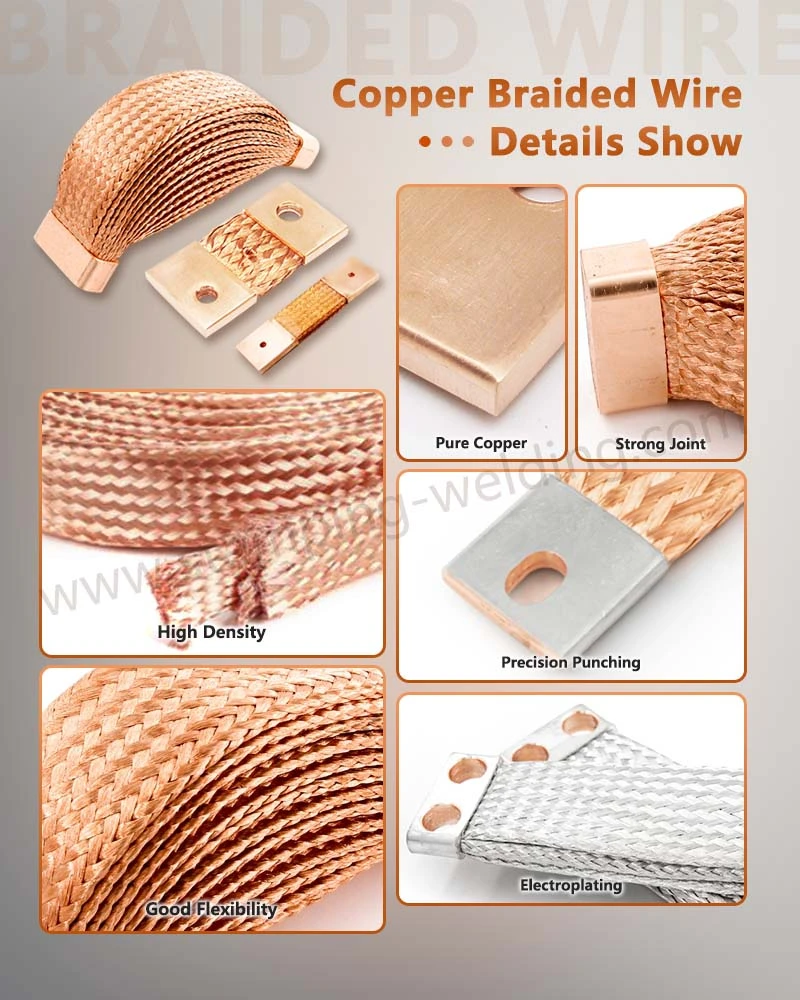
Braid density is a critical factor influencing the flexibility and mechanical properties of flexible braided busbars. Lower-density copper braid structures offer superior bending characteristics, making them suitable for connection points where installation space varies significantly; conversely, higher-density structures provide greater mechanical strength and dimensional stability, making them better suited for fixed, long-term installations.
In new energy vehicles and energy storage systems, flexible connectors must withstand vibrations and thermal cycling during operation, necessitating a balance between flexibility and mechanical strength. Flexible braided connectors utilize an interwoven multi-strand copper wire design, enabling them to accommodate a certain degree of displacement while maintaining stable current-carrying capacity.
Depending on specific application requirements, flexible busbars can be configured using single-layer braiding, multi-layer braiding, or stacked copper strip structures. While standard industrial connections may utilize simpler braiding designs, high-voltage battery systems and high-power energy storage equipment typically require structural designs that offer higher current-carrying capacity and enhanced mechanical performance.

Terminal design and surface treatment determine connection reliability
In addition to the conductor structure, the design of the terminal ends on flexible busbars is a critical factor influencing long-term performance. Terminals must ensure a stable mechanical connection and low contact resistance; otherwise, localized overheating is likely to occur during operation.
Welded terminals typically offer a more stable conductive path, making them suitable for new energy vehicles, high-voltage electrical equipment, and high-current connection applications. Crimped terminals, on the other hand, offer manufacturing flexibility and high production efficiency, making them ideal for standardized products. For projects requiring high reliability, welding, diffusion bonding, or composite connection methods are often employed to enhance the overall strength of the terminals.
Surface treatment also impacts the service life of the connection. Copper is prone to oxidation when exposed to air for extended periods, and the resulting oxide layer increases contact resistance; therefore, treatments such as tin, nickel, or silver plating are necessary to improve oxidation resistance. For instance, flexible tinned copper braided connectors utilize a tin coating to stabilize the conductor surface and minimize resistance fluctuations during long-term operation.
For applications such as new energy vehicles and battery systems, braided copper flexible connectors with tinned ends can be customized with specific terminal configurations and surface treatments to meet connection requirements across diverse operating environments.
Avoid common selection errors and improve system operational reliability
Selecting the right Braided Flexible Busbar for a real-world project can present challenges. For instance, basing the selection solely on rated current-while overlooking factors such as ambient temperature, heat dissipation conditions, and continuous operating duration-can result in an actual operating temperature rise that exceeds design limits.
Installation method is another critical factor affecting service life. Although these connectors are flexible, they cannot withstand unlimited bending or stretching. Excessive stretching, sharp bends, or twisting during installation increases the risk of fatigue in the copper strands, thereby shortening the product's lifespan.
Improper terminal treatment is also a major cause of failure. Oxidation, contamination, or insufficient contact pressure in the connection area can lead to increased contact resistance, resulting in a higher temperature rise. Consequently, the quality of terminal processing and the stability of the connection area must be strictly controlled during the design and manufacturing of these flexible copper braided busbars.
The appropriate product type must be selected based on the specific application environment. For example, grounding systems for telecommunications equipment typically require specialized flexible grounding connectors, whereas environments subject to high vibration and shock demand connection solutions with superior flexibility and fatigue resistance.
Customized Braided Flexible Busbar Solutions
Due to variations in equipment structure, current ratings, and installation environments among different clients, standardized products cannot meet every application requirement. Engineering procurement often necessitates customization based on specific project parameters-such as conductor specifications, product dimensions, terminal configurations, welding techniques, and surface treatments.
For applications involving new energy vehicles, battery packs, energy storage cabinets, and industrial electrical equipment, we offer various structural solutions-including copper braided flexible connectors, flat braided shunts, and flat flexible braided busbars. We enhance the stability of connection systems through optimized product design, sample validation, and the transition to mass production.
A sound selection process not only improves electrical performance but also reduces long-term maintenance costs, delivering more stable flexible connection solutions for new energy and industrial equipment.
Contact Us
If you are looking for a supplier of braided flexible busbars, please provide the product dimensions, current specifications, and application environment. We will assist with product selection, structural optimization, and custom development to provide a flexible connection solution that meets your project requirements.


