High-voltage Safety Upgrades: Ceramic Body For EV Fuse Strengthen The Bottom Line Of High-voltage Circuit Protection For The Entire Vehicle
Apr 26, 2026
With the continuous iteration and upgrading of high-voltage platforms for new energy vehicles, the safety protection components for the vehicle's high-voltage electrical system are entering a window of opportunity for standardization and quality improvement. The core carrier materials for high-voltage fuses have become a key area of focus for compliant R&D and mass production in the industry. The industry is focusing on core protection consumables for high-voltage circuits, deeply cultivating insulating carrier substrates suitable for all operating conditions. Among them, the Ceramic Body for EV Fuse, as a dedicated core packaging structure for high-voltage fuses, completely replaces the traditional glass tube structure of fuel vehicles, adapting to the high-voltage architecture of passenger cars and commercial vehicles, strengthening the underlying safety barrier for the vehicle's electrical operation, and meeting the stringent service standards for all vehicle scenarios.

The advantages of the substrate are highlighted
Industry data shows that the operating voltage of high-voltage electrical systems in mainstream new energy vehicles is generally stable between 300V and 1000V. Fast charging significantly increases the instantaneous overload current and circuit impact load on the high-voltage architecture. Conventional insulating plastics and ordinary glass materials are unable to withstand the combined losses from arc burning, instantaneous high temperatures, and driving vibrations. Based on an insulating carrier component made of 95% aluminum crystalline material through precision sintering-the Insulating Electrical Steatite Ceramic Fused Body-it possesses a native dense crystalline structure and a specialized strengthening molding process. This results in four core advantages: strong insulation, resistance to transient high temperatures, resistance to alternating thermal shocks, and a robust mechanical structure. It perfectly meets the stringent requirements for all-weather closed-loop protection of automotive high-voltage circuits and is suitable for complex road conditions and all driving scenarios.
Core protection performance
- High-voltage insulation and hazard avoidance: A specialized ceramic carrier adapted to high-voltage vehicle operating conditions provides long-term isolation from abnormal potential differences in high-voltage circuits, eliminating the safety hazards of leakage and creepage caused by transient high-voltage breakdown during faults. It strictly adheres to dual compliance protection standards for vehicle passenger safety and stable operation of all electronic control components, building a solid foundation for high-voltage circuit insulation.
- Temperature resistance, energy locking, and flame retardancy: In the event of a sudden short circuit or overload triggering a fuse in a vehicle circuit, the electrical circuit will instantly generate a high-energy arc of thousands of degrees Celsius. Alumina Ceramic for Bolted Connect EV Fuse maintains its integrity throughout the process, preventing cracking, softening, and carbonization. Combined with a specialized arc-extinguishing medium inside the tube, it rapidly suppresses and disperses the high-energy arc. Utilizing the integrated sealed structure of Ceramic Casing for Fuse Link, it firmly seals away high-temperature molten metal debris and instantaneous residual heat, preventing serious vehicle safety accidents such as thermal runaway in the power distribution compartment and component explosions from the source.
- All-around weather resistance and vibration resistance: The special alumina ceramic substrate has excellent thermal shock resistance and high mechanical strength, which can smoothly cope with the complex vehicle operating conditions such as frequent cold and hot start-stop at high and low temperatures, bumps and resonances on all road conditions, and all-weather parking in extreme outdoor high and low temperatures. It has no quality failures such as loosening and falling off of the shell or degradation of insulation performance during long-term vehicle installation and service, and is compatible with the safety operation and maintenance standards of the whole vehicle throughout its entire life cycle.

Full-domain vehicle adaptation
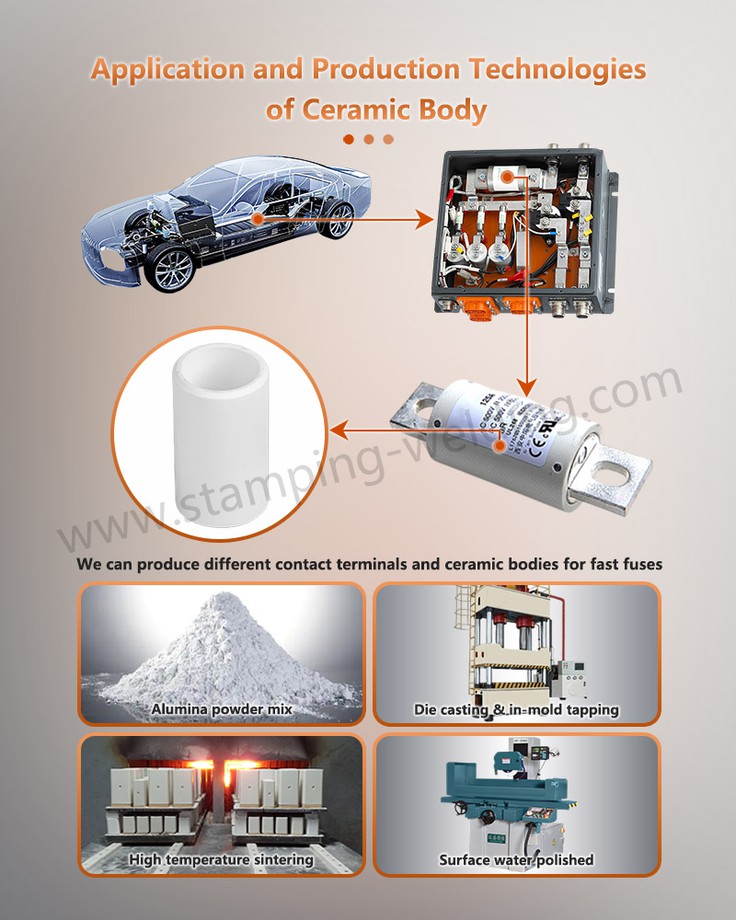
Focusing on the comprehensive application scenarios of high-voltage systems in vehicles, the Ceramic Body for EV Fuse is precisely adapted to the core high-voltage electronic control integrated unit of new energy vehicles. It is routinely installed in key assemblies such as the main high-voltage power battery BMS management system, the vehicle high-voltage power distribution box PDU, the on-board dedicated OBC charger, and the vehicle's DC/DC voltage converter, covering the entire closed-loop protection scenario of high-voltage input, energy transfer, and voltage regulation. For the differentiated protection needs of vehicle auxiliary low-voltage circuits, high-voltage fast charging dedicated branches, and bolt-integrated series power distribution branches, the industry can match and adapt dedicated base material components as needed, corresponding to multiple categories of standardized molded parts such as Ceramic Body for Electric Vehicle Auxiliary Fuse, Ceramic Tube for EV Charger Fuse Link, and Ceramic Body for Fuse Bolted Series, taking into account both mass production compatibility and the accuracy of vehicle-level graded protection, and aligning with the modular installation rhythm of automakers.
Structural performance comparison
Industry professionals interpret the complete integrated architecture of the core components, revealing that the standardized complete structure of the compliant high-voltage vehicle-mounted fuse uses a high-density ceramic sealed tube as the main load-bearing body. It incorporates a core current-conducting and fusing unit made of high-purity silver and copper impact-resistant conductive fusible elements. The cavity is filled entirely with high-purity quartz sand, a high-efficiency arc-extinguishing substrate. Both ends are matched with integrated sealed metal end caps for precise connection to the high-voltage wiring harness circuit. The entire structure is free of redundant parts and is compatible with automated assembly lines. Compared to traditional fuel vehicle glass-shell fuses, the Ceramic for DC Automotive Fuses complete component system achieves several times the rated current carrying capacity and ultimate breaking capacity. It also boasts significant advantages in arc erosion resistance, aging resistance, and long-term service performance. It is compatible with the extended warranty and maintenance requirements of the entire vehicle throughout its lifecycle, significantly reducing the after-sales electrical fault repair rate.
Industry Future Outlook
Industry analysts point out that with the widespread adoption of 800V high-voltage fast charging platforms and the continued rise in hybrid vehicle market penetration, the compliance threshold for high-voltage safety in vehicles will continue to tighten. High-purity alumina insulating ceramic carriers will become the core substrate standard in the fuse industry. Going forward, the upstream and downstream supply chains will collaborate to focus on three core areas: lightweight substrates, integrated high-strength molding, and cost reduction through low-temperature rapid sintering. This will continuously optimize the overall service performance of EV fuse ceramic bodies, contributing to improved safety, cost control, and stable mass production of high-voltage electrical systems for new energy vehicles, thus solidifying the foundation for safe and reliable electrification across the entire industry.
Contact Us
For bulk orders, customized selections, and vehicle-specific compatibility needs for Ceramic Body for EV Fuse, you can connect with our team at any time to obtain comprehensive technical solutions and readily available parts support.